Heat Waves & Extreme Heat
Human Health & the Environment
Thu Sep 4, 2025
Human Health & the Environment
Thu Sep 4, 2025
Heat Waves & Extreme Heat
Causes of Extreme Heat
What influences Heat?
While temperature is largely caused by the sun and weather systems there are other factors that influence it.
Weather
Shape of the Land
Bodies of Water
Urban Landscapes
Weather
Where the wind comes from
- Winds coming off the water will carry cooler maritime air over the warm land.
- Winds coming over the land will generally be warmer
- particularly if they’re coming from lower latitudes or the desert
Temperatures in the upper atmosphere
- Temperatures high enough above the surface aren’t influenced by daytime changes caused by the sun
- or low-level winds such as coastal sea breezes
- Air mixing throughout the day brings this upper-level air down.
- becomes warmer as it approaches the surface
- Air is more compressed at lower levels, because air pressure increases as height decreases.
- This compression increases its temperature at a rate of around 10°C/k – a process known as adiabatic warming.
Weather
Sunlight and Shade
- Air temperature is officially measured in the shade at 2 m off the ground
- away from influences that can cause fluctuations in the reading
Humidity and Wind Chill
- They’re not taken into account where temperature is measured.
Shape of the Land
Mountains and high places
- Temperatures decrease as height increases, at an average rate of 6.5°C for every 1000m.
- The atmosphere becomes thinner with height, due to gravity.
Valleys
- Valleys that dip below sea level record some of the highest temperatures on the planet.
- Valleys are excellent at collecting and holding hot air that sinks.
- Air moving down the valley from above can also add to the heat.
- This is called katabatic wind
- adiabatic warming is at play.
- This is called katabatic wind
- Sloping surfaces around the valley also mean a greater surface area is available to capture solar heat (compared to a flat surface).
- At night, valleys can become colder than surrounding areas.
- Colder air is more dense, so it will sink towards the bottom of a valley.
Bodies of Water
Water Bodies moderate Surrounding Land Temperatures
- Retain large amounts of heat.
- Take a long time to heat up and cool down compared to the land.
Ocean Currents
- Warmer currents translate to warmer land temperatures and vice versa.
- The best global example of this is the Atlantic Gulf Stream.
- Southern Europe remains much warmer than the northeast of the USA in the winter despite being at similar latitudes.
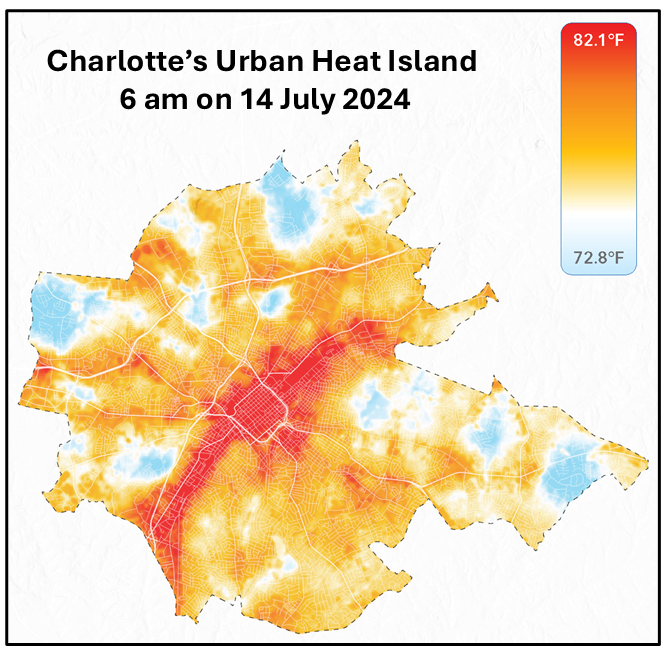
Urban Heat Island Effect
- Heat islands are urbanized areas that experience higher temperatures than outlying areas.
- Buildings, roads, and other infrastructure absorb and re-emit the sun’s heat more than natural landscapes such as forests and water bodies.
Urban Heat Island Effect
- Temperatures are different at the surface of the earth and in the atmospheric air, higher above the city.
- For this reason, there are two types of heat islands:
- Surface Heat Islands
- Atmospheric Heat Islands
- Surface temperatures vary more than atmospheric air temperatures during the day, but they are generally similar at night.
[The dips and spikes in surface temperatures over the pond area show how water maintains a nearly constant temperature day and night because it does not absorb the sun’s energy the same way as buildings and paved surfaces.]
Surface Heat Islands
- These heat islands form because urban surfaces such as roadways and rooftops absorb and emit heat more effectively than most natural surfaces.
On a warm day with a temperature of 91°F, conventional roofing materials may reach as high as 60°F warmer than air temperatures.
- Surface heat islands tend to be most intense during the day when the sun is shining.
Atmospheric Heat Islands
- These heat islands form as a result of warmer air in urban areas compared to cooler air in outlying areas.
Atmospheric heat islands vary much less in intensity than surface heat islands.
More Slides on Canva
[Click here for redirect to Canva slide deck.](https://www.canva.com/design/DAGyDPbArVU/E8sE7svnYDhQ7ZS868emFA/view?utm_content=DAGyDPbArVU&utm_campaign=designshare&utm_medium=link2&utm_source=uniquelinks&utlId=h1f82c5d936