Overexploitation
Conservation Biology
Class Meetings
Dates: 2026-10-26T16:00:00, 2026-10-28T16:00:00, 2026-11-02T16:00:00
Assigned Background
Overharvesting
Chapter: Overharvesting
Ch No.: 6 (Threats to Biodiversity)
Pages: 107-130 (Overexploitation)
PDF: peres_2010.pdf
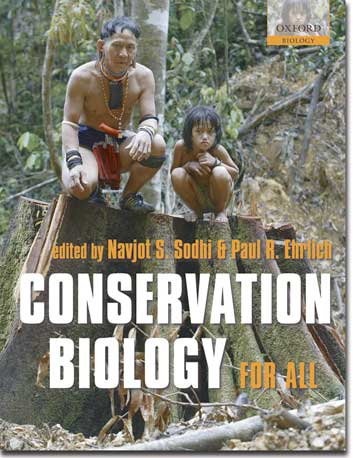
Textbook: Conservation biology for all (see details below)
Days Covered: BIOL4120_W7D1, BIOL4120_W9D2, BIOL4120_W10D1
Text: Conservation biology for all by Carlos A. Peres
Edition: (2010)
ISBN: 978-0-19-955423-2 978-0-19-955424-9
Optional Material (Dive Deeper)
Readings
Ch 10 Overexploitation
Textbook: Conservation Biology (see details below)
Chapter: 10 (Threats to Biodiversity)
Sections Assigned: 10.1, 10.2, 10.3, 10.4 (Overexploitation)
Days Covered: BIOL4120_W7D1
Text: Conservation Biology by
Edition: 2nd (2025-01-17)
ISBN: 9780197667033 (textbook)

Overharvesting
Chapter: Overharvesting
Ch No.: 6 (Threats to Biodiversity)
Pages: 107-130 (Overexploitation)
PDF: peres_2010.pdf
Textbook: Conservation biology for all (see details below)
Days Covered: BIOL4120_W7D1, BIOL4120_W9D2, BIOL4120_W10D1
Text: Conservation biology for all by Carlos A. Peres
Edition: (2010)
ISBN: 978-0-19-955423-2 978-0-19-955424-9
Video Clips
Are We Living In the Sixth Extinction
Be Smart, 11 17, 2014
Video (9:11)
Description
This time, we’re the asteroid.
Viewers like you help make PBS (Thank you 😃) . Support your local PBS Member Station here: https://to.pbs.org/PBSDSDonate
Subscribe to It’s Okay To Be Smart: http://bit.ly/iotbs_sub
Read “The Sixth Extinction by Elizabeth Kolbert: http://amzn.to/1xGKn0K
Rodolfo Dirzo et al. “Defaunation in the Anthropocene” http://bit.ly/1H7JQdw
Stuart Pimm et al. “Biodiversity of Species and Their Rates of Extinction” http://bit.ly/1A5UZJM
Get to know an endangered species: http://discover.iucnredlist.org/
Half of world’s wildlife has died off in past 40 years: http://bit.ly/1BHl8jR
Have an idea for an episode or an amazing science question you want answered? Leave a comment below!
Produced for PBS Digital Studios
Joe Hanson - Host/Writer
Joe Nicolosi - Director
Amanda Fox - Producer, Spotzen Inc
Kate Eads - Associate Producer
Katie Graham - Director of Photography
Andrew Matthews - Editing/Motion Graphics
Dalton Allen - Post-production intern
John Knudsen - Gaffer
Theme music:
“Ouroboros” by Kevin MacLeod
Stock images by Shutterstock
Join us on Patreon!
https://patreon.com/itsokaytobesmart
http://www.twitter.com/DrJoeHanson
http://www.twitter.com/okaytobesmart
http://www.instagram.com/DrJoeHanson
http://www.instagram.com/okaytobesmart
Merch
https://store.dftba.com/collections/its-okay-to-be-smart
https://www.facebook.com/itsokaytobesmartpbs/
Transcript
The history of extinction
0:02 · [MUSIC] The California Golden Bear The Great Auk The Passenger pigeon The Tasmanian tiger The Pinta Island tortoise The Golden toad All dead. And the killer is right there in the room with you.
0:22 · [MUSIC] The walls of France’s Lascaux cave hold some of humankind’s earliest art, almost mythical species: a wooly rhinoceros, enormous-antlered Megaloceros elk and massive aurochs. The artists lived on, became us, but those cave walls are the last place that those animals still run. They’re gone. Extinct.
0:51 · We all pretty much understand extinction, it’s when a species kicks the proverbial bucket, it rides off into the great biological sunset, bites the dust from whence it came and shall return, which is all just a pretty way of saying that every last one of them dies.
1:05 · Even kids are used to the idea that sometimes groups of living things just… don’t exist anymore. Okay, mostly don’t exist.
Discovering mass events
1:13 · But extinction, as a thing, is a surprisingly new concept. In the 1790’s, by studying various fossils, naturalist Georges Cuvier was the first to show that they were not from living, yet undiscovered creatures, as many thought, but from what he called “lost species”.
1:29 · In the decades to come, scientists like Charles Lyell and ol’ Chuck Darwin began to popularize the idea that Earth’s processes, like geology, evolution, and even extinction, did occur, just very, very, verrrry slowly. So slowly that we’d surely never actually see something go extinct. The idea of so-called catastrophic change was just impossible… It wasn’t until the 1980’s that scientists were able to shake that idea. Geologist Walter Alvarez was puzzled by the sudden disappearance of tiny aquatic fossils between two rock layers that dated from about 66 million years ago, the same age as the last dinosaurs.
2:01 · With the help of his Nobel Prize winning father, he analyzed the chemistry of that boundary and found iridium levels that were off the charts. Now, there’s usually not much iridium in Earth’s crust, but it’s very common in asteroids. So Alvarez’s theory? A 10-km wide rock collided with Earth, wiping out 75% of Earth’s plants and animals. To be honest scientists kinda laughed at it… until the 1991 discovery of the Chicxulub crater near the Yucatan peninsula finally settled it.
2:36 · Everything alive today is a descendent of a survivor of that terrible, horrible, no good, very bad day, the so-called Cretaceous-Paleogene mass extinction event, the most recent of the Big 5.
The big five extinctions
2:50 · You should feel pretty lucky. When we look at all of Earth’s fossil record together, 98% of the species that have ever lived are extinct,. Only they haven’t always disappeared at a constant rate.
3:02 · In the history of life on Earth, we know of 5 different mass extinctions, when a majority of life on Earth at the time disappeared in the blink of a geologic eye.
3:13 · Besides the most recent dino-killer, there’s the Triassic-Jurassic, Late Devonian, Ordivician-Silurian, and the worst of all, the End Permian. This was the mother of mass extinctions, it wiped out as many as 96% of Earth’s species, so it got the best nickname: The Great Dying.
3:34 · We’ve learned about all these just in time to get some bad news: We are in the 6th mass extinction, and this time, we are the asteroid.
The sixth mass extinction
3:46 · The hard facts of life mean that even when things are going pretty well on Earth, there’s a background rate of extinction. Among mammals, for instance, we’d expect to see one species go extinct every 700 years, or maybe one amphibian every thousand years.
4:00 · Studies of current extinction rates say we’re roughly one thousand times past that, and in some groups, like amphibians, are disappearing forty-five thousand times faster than normal.
4:13 · And since there are so many species still unknown or uncharacterized, all of those numbers are probably underestimates.
4:19 · Goodbye, gastric brooding frog, Pyrenean ibex, the Fomosan clouded leopard. We could have been friends.
4:29 · So how do we know we’re to blame?
4:32 · Around 13,000 years ago, as Earth thawed from its most recent big freeze, all of our favorite weird megafauna like the wooly mammoth, Smilodon, and our old friend Megatherium disappeared from the Earth, thanks to a changing climate and the invention of sharp stabby hunting tools. I really wish we had saved the 8-foot long beaver though. That would be awesome.
4:53 · Along the way, through hunting and farming, humans have been altering ecosystems in small but significant ways, but since the Industrial Revolution, man we have really kicked it into overdrive.
5:05 · With the exception of maybe the first bacteria to breathe oxygen into the air, no living thing has ever altered life on Earth to the degree that we have, which is why scientists now refer to current epoch as the Anthropocene.
Drivers of species loss
5:18 · “We are the ultimate problem. There are 7 billion people on the planet, we tend to destroy critical habitats where species live, we tend to be warming the planet, we tend to be very careless about moving species around the planet.”
5:32 · According to a 2014 paper by Stuart Pimm in Science (link in the doobly do), the main cause of the current extinction is human population growth and increased consumption. But those two things lead to a whole mess of threats: The most obvious are climate change and habitat destruction. Scientists found that most land species have very small ranges, so they can’t just pack up and move when we cut down their forest or turn it into a desert.
5:55 · Ocean species have more freedom to move to better waters, unless they’re coral reefs, but thanks to the highest atmospheric CO2 concentrations in 800,000+ years turning the oceans more acidic, anything with a calcium based shell has nowhere to run… or swim. If current trends hold up and the ocean hits pH 7.8 by end of century, it could wipe out ⅓ of the species in the ocean.
6:23 · Then there’s the invaders! Thanks to a species of snake hitching a ride on military cargo in the 1940s, Guam has lost all of its native birds. “I have had it with these (invasive) snakes on this (Guam-bound cargo) plane” In Africa’s Lake Victoria, 100s of species of cichlid fish species vanished after fishermen introduced the Nile Perch. Go us! We’re erasing species faster than we can even name them.
6:50 · Stanford’s Rodolfo Dirzo says that in the past 40 years, invertebrate populations, which might make up 97% of species on Earth, have declined 45% worldwide, and that’s just the ones we know about. (Link in the doobly do to that one too) You have to feel worst for the amphibians. Over the past 350 million years, they’ve survived multiple mass extinctions, but this time we’re giving them all we’ve got.
7:17 · Dirzo gives this loss of animal life a rather harmless sounding name: Defaunation. But there is nothing cute about it. There is not a group of living things on Earth today that is not threatened by the current and coming extinction. That includes us.
Why saving species matters
7:34 · Extinction is about more than gorillas, tigers, polar bears, and rhinos, and the dozens of other “famous” or “charismatic” species out there. Those are all important and worth saving, but we need to care just as much about the humble beetles, the ugly little worms, and the slimy frogs.
7:52 · Every species, big or small, panda or protozoa, is important and worth saving, whether or not we understand exactly why it’s worth saving.
8:02 · John Muir once said, “When we try to pick out anything by itself we find that it is bound fast by a thousand invisible cords that cannot be broken, to everything in the universe.”
8:15 · I’ve put some links down in the description where you can get to know some of Earth’s less-loved endangered species. Go make friends with one.
8:23 · Our knowledge and understanding of the planet’s ecosystems may be incomplete, but our effect on them knows no bounds. I hope the same tools and technology that we’ve used to push life on Earth to the edge might also give us power to bring ‘em back.
8:39 · So what are we gonna do? Let’s talk about it down there.
8:43 · Stay curious.
8:44 · If you want to read more about the brilliant and tragic stories of extinction in this age of humans, check out “The Sixth Extinction” by Elizabeth Kolbert, link in the description.
Climate change can money stop deforestation
The Economist, 11 01, 2022
Video (12:50)
Description
Rampant deforestation has driven economic growth, but accelerates climate change. How do you put a price on trees, to make them worth more alive than dead?
Film supported by Bain and Company
00:00 - Can money grow on trees?
00:55 - What Costa Rica can teach us
01:52 - Down with the trees: rapid deforestation around the world
03:15 - Why tree-planting schemes aren’t always the answer
04:24 - Paying for existing trees: carbon credits
06:38 - How to finance the restoration of forests
08:10 - What are Payments for Environmental Services?
09:31 - Swapping to sustainable returns
10:40 - Is focusing on economic growth the problem?
11.50 - Why world leaders need to decarbonise the economy
Sign up to our daily newsletter to keep up to date: https://econ.st/3n3kIjj
Why tree planting alone is not an adequate solution for climate change: https://econ.st/3rC50Oq
How the world’s wealthiest countries cause deforestation in poor ones: https://econ.st/3rBgW3d
The role of forests in climate change - listen to The Economist’s Intelligence podcast about their importance: https://econ.st/3rJ527a
How Jair Bolsonaro has damaged the Amazon rainforest: https://econ.st/3CFQiwa
Sign up to our climate change newsletter: https://econ.st/3b1dtCQ
A balance-sheet could help to save the planet:https://econ.st/3VcAZSS
Why is the Amazon rainforest doing more harm than good? https://econ.st/3T50KCV
Transcript
Can money grow on trees?
0:00 · [Music] money doesn’t grow on trees but chopping them down has helped lots of the world get richer since the beginning of the 20th century humans have been raiding these resources almost as though they were Limitless the problem is the world is now paying a heavy environmental price it certainly looks like a crisis after the worst drought in 80 years so is
0:26 · there a financial solution if we don’t change the movement of money we’ll continue to finance ourselves into Extinction is paying for trees to be protected and restored the answer and how do you put a price on their worth foreign
0:51 · to understand the alarming story of deforestation let’s start with Costa Rica in the 1980s [Music] Maria’s family was typical of many enticed by The Riches of Agriculture her father cleared and converted their Forest to pasture foreign
What Costa Rica can teach us
1:29 · markets with the driving force behind deforestation from 1940 to 1987 the proportion of land in Costa Rica covered by forests plummeted from 75 percent to 21 percent
1:45 · Costa Rica’s experience is far from unique the rest of the world jumped on the bandwagon too humans have been cutting trees for thousands of years but there was a massive acceleration in the last century the U.N estimates around 10 million
Down with the trees: rapid deforestation around the world
2:01 · hectares of forest are being lost each year that’s around 27 football fields every minute fewer trees means less carbon dioxide being absorbed from the atmosphere and their destruction only adds more emissions accelerating climate change
2:24 · The Heart Of This Global crisis sits the world’s largest rainforest and the so-called Trump of the tropics jair bolsonaro um from 2019 to 2022 the rate of
2:41 · deforestation in Brazil Rose by roughly 50 percent attracting critics around the world the problem is it’s a bit Rich for wealthy countries to demand that poorer ones give up the economic benefits of deforestation the majority of deforestation in recent
2:59 · years has really been driven by agriculture expansion in developing countries it can almost seem hypocritical to criticize these developing nations for following a pathway that effectively made rich countries wealthy in previous centuries
Why tree-planting schemes aren’t always the answer
3:15 · so what can be done the simple answer is for rich countries to incentivize poorer ones to protect and restore their forests one thing the wealthy world has tried is stumping up cash for new tree planting schemes but many of these haven’t borne
3:33 · fruit tree planting programs are incredibly popular they can seem almost childishly easy you plant a tree you save the climate the reality of course is nowhere near that simple in terms of the climate it can be far more beneficial to conserve the forest that’s there so another way is to focus rewards for
3:55 · developing countries on conserving existing forests it works like this using historic rates of deforestation a country predicts how much Forest is likely to lose in the future any Forest that it manages to conserve is judged against this Benchmark the
4:12 · donor hands over a financial reward to the developing country for the trees it saved paying a sum for each ton of carbon dioxide that would have otherwise been emitted it’s not just the developing country that stands to gain the donors often
Paying for existing trees: carbon credits
4:28 · rich countries or companies can benefit too in exchange for their money they can claim what’s called a carbon credit which they can use to offset their emissions elsewhere Carmen credits are a way of allowing companies countries people who can’t
4:47 · reduce their own emissions currently to offset those emissions elsewhere they are seen as an important part of transitioning towards a net zero economy I started out hugging orangutans but now I find myself hugging asset managers and bankers a bit more often Andrew Mitchell is a zoologist turned financial advisor he encourages investors to buy carbon credits and believes they’re an important tool for Forest conservation these credits are hugely valuable it’s a
5:18 · transition strategy whilst you’re reducing your carbon emissions you have to buy offsets you should buy offsets it sounds like a win-win but so far the results are mixed Shady players have gained the system and pulled dirty tricks like duplicating credits or
5:36 · claiming to conserve land never under threat or moving the problem to the forest next door built into the Paris agreement is this consensus that there should be a global scheme for exchanging carbon credits across borders in practice the rules and standards that would govern such a global market have been incredibly difficult to establish and so right now
6:01 · what we’ve got is a system which is really unregulated and although standards and the scale of carbon credit schemes are improving there’s still one big sticking point the rewards for conserving trees still lag behind those for deforesting we need carbon markets to grow they
6:22 · won’t really achieve their full potential unless the price of offsetting a ton of carbon is competitive with the profits that can be generated from other activities on that land ultimately conservation has to become profitable
How to finance the restoration of forests
6:38 · re-enter Costa Rica once the poster child of deforestation but now a global leader in conservation and an example of how to make saving nature pay here landowners are paid by the government to restore and conserve forests and this has helped to create new and sustainable economic opportunities [Music]
7:07 · remember Maria whose father made a living out of chopping down trees like many in Costa Rica her family have since branched out and now do the very opposite [Music]
7:24 · Maria and her grandchildren we plant forests so far 350 hectares worth the government pays them and many other families around 80 a year for each hectare of forest that’s restored or kept intact Graces
7:55 · Ramos [Music] it might sound like a government subsidy scheme but here’s the key bit it’s not
What are Payments for Environmental Services?
8:12 · it’s a system known as payments for Environmental Services launched in the late 90s is paid for by citizens who are seen as benefiting from the services provided by healthy forests like carbon storage the protection of vital food chains and clean water the money is not coming from from the national budget the money comes from those who benefit
8:38 · Carlos Manuel Rodriguez is Costa Rica’s former environment Minister and the brains behind the scheme which is paid for by a levy on consumers water bills and attacks on their fuel use Costa Rica was the first developing country that put a tax on on carbon to
8:56 · generate a revenue for the payment of Environmental Services everybody who uses fuel in Costa Rica and pollutes the environment contributing to climate change must pay in the price of purchases that fuel an extra amount that
9:13 · goes to this foreign fund that pays Farmers so far the scheme has invested more than 500 million dollars in the conservation of forests and it’s paid off in the space of a generation Forest covering Costa Rica jumped from 21 to more than 50 percent
Swapping to sustainable returns
9:32 · with the restoration of trees have come new opportunities for profitable and sustainable Industries blowing away the idea that conservation and economic development are always at loggerheads nature-based tourism has become naturally important because of our jobs in rural Costa Rica as opposed to what we had in the past which was this irrational unsustainable agricultural production there is no dichotomy between preservation and economic development
10:05 · since 1987 the peak of deforestation in Costa Rica the country’s GDP has risen by an average of 4.2 percent a year Costa Rica isn’t a magic formula for saving the world’s forests since it began prioritizing conservation it’s increased food imports an option not available to all countries but there is a lot Costa Rica can teach others for one thing it’s improved some
10:32 · of its bad spending habits reversing subsidies that incentivize the clearance of land at all costs a lead more countries should follow we should put more money into the protection of nature from governments but the reality is even if we doubled all that money it wouldn’t come close to beating the subsidies that
Is focusing on economic growth the problem?
10:52 · directly cause harm to Nature each year the world spends around 150 billion dollars on protecting nature but around 12 times that on subsidies that harm it some campaigners argue a more radical fix is needed to save the volume of forests necessary to avert environmental catastrophe they say what’s required is a fundamental shift away from society’s focus on profits and growth the problem
11:20 · with GDP is that it measures everything we build and nothing that we protect it’s all beginning to change now people are waking up to the importance of keeping nature going to keep our economy going not everyone supports such a drastic change to economic thinking but
11:36 · most do agree that change is not happening fast enough with the eyes of many global leaders on other challenges the world is facing multiple crises in the midst of all this there is a risk that nature conservation and the climate crisis are demoted in the pecking order but climate change the global climate does not wait for short-term crises to pass foreign
12:12 · bullet that will reverse climate change the world needs to urgently reduce industrial emissions and prioritize policies to decarbonize economies but unless trees are worth more alive than dead deforestation and its Devastation will continue I’m Tom standage Deputy editor of The Economist and editor of the world ahead to read more of our future gazing coverage click on the link thanks for watching and don’t forget to subscribe
Climate change the trouble with trees
The Economist, 09 18, 2019
Video (9:44)
Description
Tree-planting has been hailed as a solution to climate change. But how much can trees really do to tackle global warming? See our research here: https://econ.st/32HXvXY
Click here to subscribe to The Economist on YouTube: https://econ.st/2xvTKdy
Summer 2019 - More than 38,000 fires raged across the Amazon. Fires that were man-made. Over the past 50 years almost 17% of the world’s largest rainforest has been cleared. And globally deforestation has almost doubled in just five years.
Since the start of human civilisation it’s estimated that the number of trees around the world has fallen by almost half. Clearing forests increases carbon-dioxide levels but planting them could store away some of the carbon already in the atmosphere.
This woman runs safaris in England. Guests are not only here to see wild animals - they’re here to see wild trees.
Almost 20 years ago Isabella Tree—yes that is her real name-handed 1,400 hectares of Sussex farmland back to nature, by doing, well nothing. She thinks this is the best way to use the land to help tackle climate change.
To stabilise the climate global carbon emissions need to drop to net zero by 2050. Simon Lewis is a professor of global change science.
And there’s never been more global ambition to plant trees. In 2014, 51 countries pledged to plant over 3.5m square kilometres of forest by 2030 - an area slightly larger than India. The 2030 target looks likely to be met. But there’s a catch…
Monoculture tree plantations like eucalyptus grow quickly but the trees are harvested every ten or so years releasing much of the carbon stored in the tree back into the atmosphere - which means that, according to some studies they’ll store only around one-fortieth of the carbon natural forests do over the long term.
In fact, those pledges to plant millions of trees actually promise to store 26bn tonnes less carbon than they could. Sometimes the motives for planting forests are less green than they might appear. By 2020 Ireland ought to have cut greenhouse-gas emissions by 20% below 2005 levels. But at current rates it will have reduced them by only 5%. Planting forests might help Ireland avoid massive penalties for missing EU targets because the potential carbon these forests could store in the future can be counted as a carbon credit today. In the 1920s Ireland had the lowest forest cover in Europe at around 1%. That’s now risen to 11% and the government has set a target to cover 18% of the land with forest by 2046.
And now local community groups are protesting against these monoculture tree plantations. They say they’re doing more harm than good.
Tree-planting programmes invariably have an impact on the people living nearby. In east Africa one project is demonstrating what can be achieved
when there’s genuine buy-in from the local communities. Green Ethiopia is a mixed-tree planting charity.
The land is communally owned and co-operatives of local women receive benefits for planting trees which are protected from being harvested. Here conserving is just as important as planting. Green Ethiopia assesses whether the condition of the land is good enough to regenerate by itself. When it is—on about a third of the area the charity runs they leave it alone. Just like Isabella Tree, back in England.
Monoculture plantations are often preferred because they make money. So some experts are looking to a future where carbon payments could create financial incentives for natural forests. Ultimately though, the trouble with trees tackling climate change is space
For more from Economist Films visit: http://films.economist.com/
Check out The Economist’s full video catalogue: http://econ.st/20IehQk
Like The Economist on Facebook: https://www.facebook.com/TheEconomist/
Follow The Economist on Twitter: https://twitter.com/theeconomist
Follow us on Instagram: https://www.instagram.com/theeconomist/
Follow us on Medium: https://medium.com/@the_economist
Transcript
The deforestation crisis
0:00 · Summer 2019 More than 38,000 fires raged across the Amazon…
0:05 · …fires that were man-made Over the past 50 years…
0:10 · …almost 17% of the world’s largest rainforest has been cleared And globally deforestation has almost doubled in just five years Since the start of human civilisation…
0:23 · …it’s estimated that the number of trees around the world…
0:26 · …has fallen by almost half Clearing forests increases carbon-dioxide levels…
0:33 · …but planting them could store away…
0:35 · …some of the carbon already in the atmosphere Everyone is looking for a silver bullet…
0:41 · …to get our way out of this really difficult problem of climate change Some people have latched on to tree planting as a kind of panacea But the reality is tree planting is not always good This woman runs safaris…
The case for wilding
1:05 · …in England Guests are not only here to see wild animals…
1:12 · …they’re here to see wild trees If you could imagine when we were farming…
1:19 · …back in the 1980s, through the 90s…
1:22 · …this would have been a field of one particular crop as far as the eye can see Almost 20 years ago Isabella Tree—yes that is her real name…
1:32 · …handed 1,400 hectares of Sussex farmland back to nature…
1:36 · …by doing, well nothing She thinks this is the best way to use the land to help tackle climate change Wilding is a hands-off approach It’s become a sort of environment that is a nursery…
1:51 · …for open-grown, freely regenerating trees Within 20 years we have doubled our carbon sequestered in the soil We’ve got the scrub, we’ve got the grasses, we’ve got the trees…
2:04 · …all that will be contributing to this carbon sink To stabilise the climate global carbon emissions…
The pitfalls of planting
2:12 · …need to drop to net zero by 2050 Of course not all sectors are going to get down to zero emissions by 2050 Simon Lewis is a professor of global change science We need to take some carbon out of the atmosphere…
2:28 · …and one of the cheapest and easiest ways is to plant trees Around half the dry weight of a tree is carbon As trees grow they take carbon out of the atmosphere…
2:40 · …and store it in their trunks, leaves and roots…
2:42 · …which helps slow the rate of climate change And there’s never been more global ambition to plant trees In 2014, 51 countries pledged to plant…
2:53 · …over 3.5m square kilometres of forest by 2030…
2:58 · …an area slightly larger than India Ethiopia has made its mark in the record books…
3:05 · …by planting over 350m trees in a single day The 2030 target looks likely to be met But there’s a catch… When you dig down into the numbers of these forests…
3:20 · …almost half the area pledged so far by countries…
3:24 · …is actually from monoculture plantations And that means a single species planted over…
3:31 · …thousands and thousands of hectares Monoculture tree plantations like eucalyptus grow quickly…
3:37 · …but the trees are harvested every ten or so years…
3:40 · …releasing much of the carbon stored in the tree…
3:42 · …back into the atmosphere…
3:44 · …which means that, according to some studies…
3:46 · …they’ll store only around one-fortieth of the carbon…
3:49 · …natural forests do over the long term It’s made into short-term products like paper…
3:55 · …and then when that paper is used and then discarded…
3:58 · …it decomposes and that carbon goes back into the atmosphere Simon analysed pledges from 43 countries in the tropics and sub-tropics These big announcements are not going to deliver…
Policy and ecological impacts
4:10 · …on the carbon capture that we’re expecting If they were all natural forests we would sequester…
4:17 · …42bn tonnes of carbon this century In fact, those pledges to plant millions of trees…
4:25 · …actually promise to store 26bn tonnes less carbon than they could Sometimes the motives for planting forests…
4:34 · …are less green than they might appear By 2020 Ireland ought to have cut greenhouse-gas emissions…
4:41 · …by 20% below 2005 levels But at current rates it will have reduced them by only 5% Planting forests might help Ireland avoid massive penalties…
4:53 · …for missing EU targets…
4:55 · …because the potential carbon these forests could store in the future…
4:58 · …can be counted as a carbon credit today In the 1920s Ireland had the lowest forest cover in Europe at around 1% That’s now risen to 11% and the government has set a target…
5:12 · …to cover 18% of the land with forest by 2046 In Ireland, they’re rapidly increasing the amount of forest cover But it’s overwhelmingly going towards monoculture plantations of conifers And now local community groups are protesting against…
5:33 · …these monoculture tree plantations They say they’re doing more harm than good Because these monoculture plantations are about getting…
5:42 · …the maximum yield as fast as possible they often apply fertilisers…
5:47 · …which contribute to greenhouse gas nitrous oxide Conifer plantations are very densely stocked…
5:56 · …so cut out almost all the light…
5:58 · …are very poor for biodiversity and can really affect people living nearby Tree-planting programmes invariably have an impact…
Community-led regeneration
6:09 · …on the people living nearby In east Africa one project is demonstrating what can be achieved…
6:15 · …when there’s genuine buy-in from the local communities Green Ethiopia is a mixed-tree planting charity We plant seedlings in rural areas of Ethiopia…
6:27 · …that is heavily affected by degradation due to deforestation The land is communally owned…
6:34 · …and co-operatives of local women receive benefits for planting trees…
6:38 · …which are protected from being harvested Empowering the local community on tree planting…
6:47 · …contributes a lot for the sustainability of our forestation activities…
6:51 · …because it creates a sense of ownership The local communities strongly participate…
6:58 · …in planting, managing and conserving the sites Here conserving is just as important as planting Green Ethiopia assesses whether the condition of the land…
7:13 · …is good enough to regenerate by itself When it is—on about a third of the area the charity runs…
7:19 · …they leave it alone Just like Isabella Tree, back in England Perhaps the right way to think about tree planting is…
7:30 · …just leave the land and it can do it spontaneously itself There is no need for interventions by humans in most cases But this approach brings its own challenges The problem with this kind of natural regeneration is that…
Limits of the tree solution
7:45 · …it’s very difficult to get funding The funding is all driven by targets…
7:51 · …the numbers game In a regenerated landscape like this…
7:55 · …we can’t have any idea of how many oaks there’ll be…
7:57 · …or how many crab apples will come Monoculture plantations are often preferred because they make money So some experts are looking to a future where…
8:07 · …carbon payments could create financial incentives for natural forests If carbon becomes much more important as a commodity…
8:16 · …then perhaps these natural forests would become…
8:20 · …more profitable than plantations There’s a real opportunity here to shift the incentives…
8:27 · …towards getting benefits for the climate…
8:30 · …and benefits for local people and benefits for local wildlife Ultimately though, the trouble with trees tackling climate change is space There’s just not enough land in the world to plant enough trees…
8:47 · …to offset all the carbon emissions from fossil fuels We could say let’s restore forest on every single piece of land…
8:54 · …that used to have forest on from before agriculture And if we did that it would be about 200bn tonnes of carbon Now that sounds a lot but to put it in context…
9:05 · …that’s about 20 years’ worth of emissions at present rates Tree planting might be looked at as a saviour But it’s not It’s not an excuse not to cut fossil-fuel emissions
How poaching is changing the face of African elephants
Vox, 03 15, 2017
Video (5:21)
Description
It’s “natural” selection.
Subscribe to our channel! http://goo.gl/0bsAjO
Many thanks to Dr. Joyce H. Poole, Dr. Tammie Matson, Andrew Parker, and African Parks. To learn more about their ongoing work in elephant conservation, visit their websites below:
https://500elephants.org/
https://www.african-parks.org/
https://www.elephantvoices.org/
https://matsonridley.com/
And for a little pick-me-up…
Cute Baby Elephants
https://youtu.be/SNggmeilXDQ
https://youtu.be/JHlWvn_RCQI
https://youtu.be/UeTmE71uEaw
https://youtu.be/gAYCbnEZ4p8
https://youtu.be/t2kAPfUEaZM
Elephants and their ancestors have roamed the African continent for millions of years. They are the largest land animals on earth and can live up to 70 years. Elephants are profoundly intelligent and social creatures. They have trunks that serves as their nose, arm, and fingers. But elephant populations have taken a massive hit to their populations. Despite an international ban on the ivory trade and other laws to protect elephants, their overall populations continue to fall due to habitat loss and rampant poaching for their tusks. Because of that, a once rare trait is being passed onto more African elephants. The trait is tusklessness, The loss of tusks is only the beginning. The real devastation occurs with the loss of a groups matriarch. The oldest and most experienced grandmothers are the family’s living memory of migration routes, friendly elephants, food and water sources, etc. Matriarchs are also, the first in line to protect their families and without them an entire group of elephants can fall apart. But with China banning ivory in 2017, providing stronger incentives to protect elephants, and sustained conservation efforts from organizations like ElephantVoices, African Parks, and others, elephants may stand a chance to roam the continent as their ancestors once did.
Vox.com is a news website that helps you cut through the noise and understand what’s really driving the events in the headlines. Check out http://www.vox.com to get up to speed on everything from Kurdistan to the Kim Kardashian app.
Check out our full video catalog: http://goo.gl/IZONyE
Follow Vox on Twitter: http://goo.gl/XFrZ5H
Or on Facebook: http://goo.gl/U2g06o
Transcript
0:00 · Elephants are one of the most iconic creatures on this planet.
0:04 · They’re the largest land animals, the only surviving members of their order, and they’re highly intelligent, social beings.
0:10 · Reporter #1: “They’re a lot like human babies, actually.”
0:12 · Reporter #2: “These elephants in Thailand can even paint.”
0:14 · Reporter #3: “It is the matriarch who guides the herd. It’s the older females vast life experience that gives them these skills.”
0:23 · African elephants have been here for a million and a half years. And now, human intervention is literally changing the face of this incredible creature.
0:31 · During the 1500s, an estimated twenty-six million elephants roamed the African continent.
0:39 · Today, it’s less than 500,000.
1:03 · In the 1970s and 80s, elephant poaching reached crisis-levels, so in 1989, an international agreement banned the global ivory trade.
CITES (Convention on International Trade in Endangered Species of Wild Fauna and Flora)
1989 1990 Ban goes into effect
1:13 · But in the past several years, poaching has returned to high levels. This chart shows the percentage of african elephant deaths caused by poaching since 2003.
1:21 · Their ivory tusks are basically just large teeth, but for centuries, they’ve been used in artworks, ornaments, jewelry – even piano keys.
1:28 · Ivory’s value has been compared to diamonds – it’s a status symbol.
1:33 · And the rise of China’s middle class has pushed up demand for ivory there, where it sells for around $1100 per kilogram.
1:48 · One-third of an elephant’s tusks are in its skull which contains a pulpy cavity of tissues, blood vessels, and nerves.
1:55 · That means they can’t be preemptively removed by conservationists, an approach that has been applied to rhino horns, which aren’t ivory but are also sought after in Asia.
2:07 · Conservationists can safely remove up to 93% of a rhino’s horn, but it’s not possible to remove that much from elephants.
2:15 · But in recent decades there’s been an increasing trend of elephants being born tuskless.
2:30 · While most African elephants of both sexes have tusks, around 2 to 6 percent are naturally born tuskless.
2:37 · Now, decades of heavy poaching have made that trait more common.
2:41 · This chart shows that elephant populations subject to poaching have higher rates of tusklessness compared to undisturbed populations.
2:49 · Let’s use Gorongosa National Park as an example.
Gorongosa National Park
The Mozambican Civil War
2:57 · Of the older female elephants who survived the war, over half were tuskless.
3:03 · And of the younger females born after the war, 33% were tuskless.
3:09 · Because tuskless elephants were less likely to be killed by poachers, the tuskless trait became more common in the next generation.
3:16 · Scientists have also found that on average, tusks are smaller than they were a century ago.
3:41 · Like tusklessness, smaller tusks provide a survival advantage against poaching. But it comes at a cost.
4:10 · Tusklessness is not likely to save the species from poaching and habitat loss.
4:17 · Yet, there is some hope.
4:19 · Through determined conservation efforts, some African national parks are seeing growth in their elephant populations.
4:27 · And China has announced that by the end of 2017, they will end domestic sales and processing of ivory.
BBC China announces ban on ivory trade by end of 2017
4:34 · Those steps, along with stronger incentives to protect elephant habitats and support local anti-poaching programs, might give elephants the leg or tusk up they need to secure their future on this planet.
4:50 · A big thanks to African Parks and the experts I got to interview for this video.
4:59 · If you wanna learn more about their work in elephant conservation, links to their web sites are in the description box.
5:06 · And if you need a little pick-me-up, don’t worry I got you covered.
5:10 · Links to baby elephant videos are in there too.
Project aims to count Africa’s shrinking elephant population
PBS NewsHour, 01 17, 2015
Video (8:10)
Description
The Great Elephant census, an ambitious two-year initiative funded by an American philanthropist, aims to count all of the elephants in Africa to save the species. But as numbers continue dwindle, due in large part to poaching, researchers – already faced with a herculean task and countries resistant to join the census – must first establish how many they are trying to save.
Transcript
Selection for Tuskless Elephants HHMI BioInteractive Video
biointeractive, 09 23, 2016
Video (6:39)
Description
Working in Gorongosa National Park, Mozambique, Dr. Joyce Poole and colleagues make a striking observation: many female elephants lack tusks.
Most African elephants have tusks, but some–about 2 to 6% of females and even fewer males—never grow them. Elephant tusks are important for obtaining food and water, and essential to male elephants for competing for mates, so there is a strong natural selection for having tusks. But the proportion of tuskless elephants has increased in some populations. In this video Dr. Joyce Poole explains a possible reason. Elephants with large tusks are targeted by poachers who sell the tusks on the ivory market. Poaching is artificially selecting for tuskless elephants who can better survive, mate, and pass on their genes to the next generation. In Gorongosa National Park, Poole found that among the older female elephants, who survived a period of heavy poaching in the park, over 50% are tuskless. Among the younger females, who were born after this period of heavy poaching, 33% are tuskless.
For more short films and resources on elephants, visit http://www.hhmi.org/biointeractive/elephants
Transcript
0:11 · DOMINIQUE DEMILLE: Oh, they is coming.
0:18 · NARRATOR: For over 40 years, Joyce Poole has been studying elephant populations in Africa.
0:26 · She’s one of the world’s experts on elephant behavior and communication.
0:30 · Her work has taken her to Gorongosa National Park in Mozambique, where she’s working with local scientists.
0:37 · DEMILLE: Oh, the big guy is coming out, right?
0:42 · JOYCE POOLE: He’s the same guy on the camera traps who was in the farms.
0:47 · I’m studying the status of the Gorongosa elephants, looking at how they have and are recovering from a period of heavy poaching.
1:00 · NARRATOR: Many of the large mammals, and over 90% of Gorongosa’s elephants were killed during a civil war that lasted from 1977 to 1992.
1:12 · POOLE: So even though it’s 20 years, we can see that there’s real scars on this population.
1:20 · DEMILLE: [SPEAKING PORTUGUESE] NARRATOR: The scientists are monitoring a peculiar characteristic, one that they’ve also seen in other African parks.
1:42 · Some elephant populations seem to be missing their tusks.
1:50 · Since 2008, the Gorongosa Restoration Project has been protecting wildlife in the park and monitoring their recovery.
1:57 · The elephant population is slowly growing back to a healthy size.
2:02 · DEMILLE: [SPEAKING PORTUGUESE] NARRATOR: By studying the recovery of Gorongosa’s elephants, Poole observed that many females lacked tusks.
2:24 · POOLE: The first day I was here in 2011, I met a group of 50 elephants.
2:29 · Most of them were tuskless.
2:31 · So I knew straight away when I came here that there was a high proportion of tusklessness.
2:43 · NARRATOR: Tusks are a pair of elongated teeth, the incisors, that continue to grow throughout an elephant’s lifetime.
2:53 · Elephants use their tusks to strip bark off trees and dig holes for water and minerals.
3:04 · Males use them in contests against other males to win over females.
3:10 · POOLE: Elephants use their tusks all the time.
3:12 · For males, tusks are really important because males are fighting one another for access to females.
3:19 · And if you don’t have tusks, you risk being severely wounded.
3:24 · So there’s a very strong selective pressure among males for tusks.
3:30 · NARRATOR: Because tusks are so critical to the survival of males, tuskless males are extremely rare.
3:37 · But a proportion of female elephants are typically tuskless.
3:41 · In populations less affected by poaching, tuskless females are only 2% to 6% of the total number.
3:47 · POOLE: Tusklessness, just like having tusks, is a natural trait.
3:54 · And it’s inherited, like bigger ears or smaller ears, or green eyes or blue eyes.
4:00 · It’s an inherited characteristic.
4:03 · NARRATOR: During the Civil War in Mozambique, large-tusked elephants in Gorongosa were killed for their ivory, which was sold to buy arms and ammunition.
4:15 · More of the tuskless female elephants survived.
4:17 · POOLE: Here in Gorongosa, among the older age class, that is, the ones who were already adults during the war, when there was heavy poaching, they are 50% tuskless.
4:30 · NARRATOR: Poaching selected for tuskless females.
4:33 · POOLE: It ends up with a higher proportion of tuskless animals, who then reproduce, and tend to produce tuskless offspring.
4:44 · NARRATOR: Surveys conducted by Poole and colleagues indicated that 33% of females 10 to 20 years old are tuskless.
4:53 · No tuskless males have been found.
4:56 · POOLE: Any animal who’s under 20 was born after the war.
5:01 · So they are not a consequence of poaching, or at least not directly, but they would be a consequence of maybe being born of tuskless mothers.
5:14 · NARRATOR: Poole has observed large tuskless populations in other African countries where elephants are heavily poached to support the ivory trade.
5:22 · POOLE: Somewhere like the Selous in southern Tanzania, Queen Elizabeth.
5:28 · Both of those populations went through heavy poaching in the ’80s, and Selous, again, now.
5:35 · And they have also very high levels of tusklessness.
5:41 · In this day and age now, with all the poaching that’s going on, actually, the tuskless elephants are at an advantage because they are not being targeted for their tusks.
5:55 · NARRATOR: The insatiable demand for ivory is driving complex changes in elephant populations.
6:03 · Not only are elephant numbers decreasing across the African continent due to habitat loss and poaching, but elephant traits are also changing as a result of this ongoing threat.
The Everyday Ingredient Destroying the Planet
Bloomberg Originals, 04 05, 2023
Video (11:56)
Description
Kal Penn investigates the damage being done by the palm oil industry in Indonesia. The product is used in everything from cookies to shampoo, but its production has laid waste to forests all over the globe. With only 20% of palm oil deemed sustainable, Penn looks for solutions, including a UK startup with a lab-made version. But can fake palm oil compete with nature in quality and price?
Getting Warmer is Bloomberg’s exclusive new show about climate, clean energy and business, anchored by actor and former White House aide Kal Penn.
Accompany him on his journey as he takes an up-close look at bold climate solutions and discovers new facets of the global transition to clean energy.
In a hosted studio segment, Penn sifts through the overwhelming news about our climate and breaks down the facts and trends to understand with a dose of humor and optimism. Why are the recycling symbols on your plastic cups misleading? How does the carbon credit market work and does it actually help? And what is the future of water in a drought-ridden world?
On the road, Penn meets the innovators, researchers, communities and businesses pivoting to new energy sources and spearheading low-carbon technologies. In documentary segments, Penn speaks to the self-declared “crypto cowboys” of Texas who claim Bitcoin mining can help stabilize the state’s troubled electrical grid, and travels to Nevada to visit the company attempting to build America’s first closed-loop supply chain for electric vehicles. In New York, Penn explores the urban designs proposed to save the city from the next Superstorm Sandy and goes inside New York’s Empire State building to investigate the challenges of decarbonizing our cities and landmarks.
The show builds on, and includes contributions from, Bloomberg Green’s award-winning team of climate journalists as well as London-based climate storytellers Jack Harries and Alice Aedy. With a focus on the most pressing questions for young viewers, Jack and Alice unpack one big idea each episode. From recycled wastewater to regenerative agriculture and the challenges of a just transition for workers in the energy sector, they’ll break down how countries across the world are finding intriguing solutions to our climate crisis, and outline the challenges ahead.
Watch Getting Warmer starting February 1st at 8p EST streaming on Bloomberg channels on Connected TV Devices including Samsung TV+, LG Channels, and Fire TV. And on & Bloomberg.com.
You can also watch on Bloomberg TV (BTV) at 10p ET.
Like this video? Subscribe: http://www.youtube.com/Bloomberg?sub_confirmation=1
Become a Quicktake Member for exclusive perks: http://www.youtube.com/bloomberg/join
Bloomberg Originals offers bold takes for curious minds on today’s biggest topics. Hosted by experts covering stories you haven’t seen and viewpoints you haven’t heard, you’ll discover cinematic, data-led shows that investigate the intersection of business and culture. Exploring every angle of climate change, technology, finance, sports and beyond, Bloomberg Originals is business as you’ve never seen it.
Subscribe for business news, but not as you’ve known it: exclusive interviews, fascinating profiles, data-driven analysis, and the latest in tech innovation from around the world.
Visit our partner channel Bloomberg Quicktake for global news and insight in an instant.
Transcript
The ubiquitous palm oil
0:03 · Palm oil.
0:04 · You’ve probably heard of it, yet don’t know exactly what it is.
0:08 · But unless you’re on an exclusive nut and berry diet you’re probably eating some today.
0:13 · Or at least rubbed some on your body this morning.
0:18 · The miraculous, versatile substance is used in thousands of everyday products, from chips and ice cream to shampoo and fuel.
0:27 · On average, we consume about eight kilograms, or around 18 pounds of palm oil every year.
0:35 · It comes from the red fruits of an oil palm tree.
0:43 · Palm is usually not a whole ingredient in something, with the exception of cooking oil.
0:50 · We’re often using a fraction.
0:52 · It’s a part of the fruit, a part of the oil, so it’s really easy for that to be invisible within a product.
1:01 · Seems like the ultimate natural resource, right?
1:03 · Just pick the fruit off the tree and make stuff with it.
1:06 · But palm oil has become very controversial in recent years for its cost on the environment.
Environmental controversy
1:12 · Vast swaths of forests have been burned by farmers to make way for oil palm plantations, causing the wholesale destruction of natural habitats, and ultimately contributing to climate change.
1:24 · There have also been reports of serious labor rights abuses in the industry.
1:57 · Despite public and private sector efforts to mitigate palm oil’s environmental impact, only 20% of the world’s palm oil is certified as sustainable today.
Seeking sustainable solutions
2:07 · Like most problems related to the climate crisis there doesn’t seem to be one clear solution.
2:13 · The damage being done by the palm oil industry is significant and not going away anytime soon.
2:19 · But farmers, big companies, and scientists are working in their own ways to try to chip away at its negative effects.
2:27 · The way that we produce food now is a modern miracle, but it’s also having an enormous impact on the environment.
2:33 · We have to create changes.
2:34 · We have to work towards creating these novel foodstuffs, which have much lower impact, which are healthy, and delicious, and different to what we had before.
Smallholder farmer challenges
3:26 · Edy is one of 16 million people working in the palm oil industry in Indonesia, the world’s biggest palm oil producer, churning out about 47 million tons in 2020 alone.
4:00 · About 40% of the oil palm plantations in Indonesia are owned by small scale farmers like Edy, who have less than 25 hectares of land.
4:10 · But many small holders didn’t have an understanding of sustainable farming.
4:14 · Slashing and burning the forest was common because it was the cheapest and fastest way to make land to grow oil palm trees.
4:22 · Between 2005 and 2013, almost half of the deforestation in Indonesia was linked to oil palm cultivation.
4:30 · 2015 was the worst year.
4:32 · Between June and October, fires burned an area roughly the size of Rwanda, or the US state of Maryland.
4:40 · Researchers linked the toxic haze, which lingered for weeks, to more than 100,000 premature deaths in Indonesia, and in neighboring countries like Malaysia and Singapore.
5:07 · In 2016, Indonesian president Joko Widodo imposed a moratorium on new permits for clearing forest and peatland for oil palm cultivation.
5:18 · Deforestation linked to palm oil is still happening, but educational campaigns and stricter law enforcement have reduced it significantly.
5:28 · More farmers like Edy have joined small holders associations like this one.
5:32 · With financial support from NGOs and big companies, they’ve got certification from institutes like the Roundtable on Sustainable Palm Oil, or RSPO.
5:42 · Sustainable palm oil has to meet strict standards, such as using best farming practices, conserving the environment, and considering employees benefits and rights.
5:52 · But Edy’s only one of a tiny number of certified small holders because many farmers don’t have the resources or access to get certified.
6:00 · And challenges still remain after being certified.
Big oil industry impact
6:28 · The other piece of the puzzle is big palm oil companies.
6:35 · Here at Golden Agri-Resources, we have more than 500,000 hectares of palm oil plantations across Indonesia, but we also buy fresh fruit bunches from other producers of palm.
6:48 · And so we actually trade and process closer to around six to eight million tons of what’s called crude palm oil, or palm related products.
7:00 · Harvested fruit bunches are sent to mills and then refineries for processing.
7:06 · The outer orange part of the fruit creates crude palm oil, which can be turned into many different products, like cooking oil and biofuel.
7:14 · The white creamy substance inside the kernel creates palm kernel oil, which is used in cosmetics, soaps, and hand sanitizers.
7:24 · In the past, criticism of the industry in terms of its impact on forests, wildlife, and even on local communities, sadly, was justified.
7:41 · We wanna be able to produce the equivalent of a million hectares of land on that half a million hectares of land.
7:48 · So focusing on using biotechnology techniques, but also really good farming practices.
7:56 · But full traceability of the supply chain still remains a challenge.
8:00 · Third party plantations are usually in remote locations spanning millions of hectares.
8:06 · Another challenge is consumer commitment.
8:08 · About 20% of the world’s palm oil was certified as sustainable, but buyers only bought half of it.
8:15 · So the greatest demand still comes from buyers in Europe and the US, to a certain extent Australia.
8:22 · However, the largest volumes are sold in countries like Indonesia, Malaysia, India, and China, where demand for a sustainable product is still very low.
Developing lab alternatives
8:40 · Making palm oil production sustainable is crucial, but some scientists are hoping we could stop using it completely.
8:46 · But the researchers working on an alternative to palm oil will need to ensure their products are competitive in quality and price.
8:54 · Ultimately, there’s no mystery to palm oil.
8:56 · It’s a relatively simple group of compounds of which other organisms can make as well.
9:01 · And that’s what we’ve been able to mimic with the yeast.
9:04 · So this process is very similar to brewing beer, technology we’ve known about for thousands of years.
9:10 · Where, when you brew beer, you take sugars and grow a brewing yeast on them, which produces ethanol, which we can drink.
9:18 · In our process, we’re using natural yeast, which naturally make edible oils.
9:24 · Finding the right yeast is key.
9:26 · After a few years of researching and experimenting, the team found metschnikowia pulcherrima, a yeast that grows on the surface of grapes all over the world.
9:35 · And then they spent another eight years developing the yeast and the process to grow it.
9:40 · Here, we have to use large drums of eight kilograms of the sugar.
9:44 · It’s dragged into the reactor here and then fed to the yeast.
9:47 · Now here we have 50 liters of culture, and this is enough to make kilograms of yeast in a week.
9:54 · This is also a really good mimic to demonstrate what an industrial process will truly look like on the large scale.
10:02 · So the yeast we selected at first didn’t make much oil, but it had a number of other attributes which allow us to produce it on the large scale.
10:10 · So it could be produced under a wide temperature range.
10:14 · It could be produced under a wide range of pHs.
10:17 · It also can use a whole range of sugars, saccharides, and proteins to grow, which allows us to use waste resources very efficiently.
10:25 · The team has completed research and development, successfully fed the yeast with waste food like coffee grounds, and agricultural leftovers like wheat straw and sawdust.
10:35 · Now, they’re running a pilot, producing kilograms of palm oil substitute per week.
10:40 · And aim to increase that to tons per week within a year.
10:44 · So here we have the yeast.
10:45 · And you have these giant cells, which are then full of oil, which we can extract.
10:51 · A startup has been spun out from the project, raising over $2.5 million, with the goal to bring the product to grocery store shelves.
10:59 · In the last few decades, we’ve seen people really starting to choose alternative products, alternative analogs to meat, for example.
11:06 · Products like yeast protein from corn.
11:09 · We see ourselves as continuing that journey and being the next generation of novel foods.
Future of the industry
11:15 · Regardless of what the future holds, the palm oil industry needs to make serious changes today.
The salmon dilemma
Vox, 11 13, 2025
Video (7:55)
Description
Earth’s population is growing. We’re expected to have 2 billion more mouths to feed by 2050. But how can we feed all those people in a way that is still sustainable and ethical? Many have argued that aquaculture (or fish farming) is one of the most sustainable ways we can consume animal protein, since it requires less land use. It’s currently the quickest-growing form of food production in the world. But how exactly does it work? And is it really the best path forward?
To find out more, Vox video producer Nate Krieger went down the rabbit hole on salmon aquaculture. Salmon is currently the most popular fish in the US: The average American consumes 3.2 pounds of salmon annually. And over 70% of that salmon comes from farms, totalling 3 million tons of salmon a year.
To understand the impact that the salmon industry is having on our planet and our future, and on the salmon themselves, we spoke to industry insiders, marine biologists, and fish welfare experts.
This is a complicated issue, full of lots of caveats and trade-offs. But the more we know about the food we eat and where it comes from, the more responsible we can be.
Sources and further reading:
Read more of Vox’s reporting on salmon farming: https://www.vox.com/future-perfect/468348/atlantic-salmon-farm-cruelty-pollution
Vox’s Future Perfect team reports on what it takes to feed the fish involved in aquaculture, which turns out to be one of the most important impacts to consider:
https://www.vox.com/future-perfect/464898/trump-tariffs-china-trade-war-soybeans-exports
https://www.vox.com/future-perfect/379564/fish-farming-sustainable-wild-caught
The website for the Global Salmon Initiative, a collaboration between some of the world’s biggest salmon farming companies, whose CEO we spoke with for this piece. Its handbook is a great resource for information on salmon aquaculture:
https://globalsalmoninitiative.org/en/about-salmon-farming/gsi-handbook/
The World Wildlife Fund’s page on the tradeoffs involved in salmon farming: https://www.worldwildlife.org/our-work/oceans/sustainable-seafood/farmed-seafood/farmed-salmon/
This video is part of a series supported by Animal Charity Evaluators, which received a grant from EarthShare.
Subscribe to our channel! http://goo.gl/0bsAjO
Vox.com is a news website that helps you cut through the noise and understand what’s really driving the events in the headlines. Check out http://www.vox.com.
Watch our full video catalog: http://goo.gl/IZONyE
Follow Vox on Facebook: http://goo.gl/U2g06o
Or Twitter: http://goo.gl/XFrZ5H
This video has been updated to remove fish research footage.
Transcript
0:00 · I eat meat.
0:01 · I also eat a lot of other things.
0:03 · Which makes me an omnivore, like a lot of people.
0:05 · But lately I’ve been wondering, is it even possible to be an omnivore responsibly?
0:10 · I mean, is it possible to eat meat and still care about this planet?
0:14 · I’ve been hearing a lot about farming fish as one of the most sustainable and ethical ways to produce animal protein.
0:20 · So I decided to do a deep dive on the most consumed fish in the US.
0:24 · Salmon.
0:25 · I personally eat a ton of salmon, and I’m not alone.
0:29 · The average American consumes 3.2 pounds of salmon a year.
0:33 · So how exactly does salmon farming work?
0:36 · I’ll explain the impact it has on our planet and our future, and maybe most importantly, what it means for the salmon themselves.
0:47 · So, first things first.
0:49 · Wild or farmed salmon.
0:50 · Wild does sound a lot better to me.
0:53 · But it turns out there’s a very real limit to how much wild salmon we can catch sustainably.
0:58 · We’re unfortunately at this state right now where to put it simply, the wild fish stocks are just maxed out or are almost at their sustainability limits.
1:07 · And to meet the rising demands for seafood, you know, we need to not deplete the oceans any more.
1:13 · We need them to be thriving and to be, you know, full of biodiversity and and that’s where aquaculture can come in.
1:18 · So if we want to eat salmon at the scale that we do well, it kind of sounds like it has to come from aquaculture.
1:24 · Salmon has only been farmed since the 1960s, and it’s grown fast. Since the 80s, global consumption of salmon has tripled.
1:32 · And over 70% of that salmon comes from farms.
1:34 · So salmon farming takes place in coastal regions around the world.
1:38 · You know, salmon really like that cold, clean, fresh water where they like to grow best.
1:42 · That’s Sophie Ryan, CEO of Global Salmon Initiative, a collaboration between some of the world’s biggest salmon farming companies.
1:49 · Most salmon is farmed in Norway, Chile, the U.K., Canada, and the Faroe Islands.
1:54 · The process really begins in what we call a freshwater hatchery.
1:58 · So this is locations on land where the salmon are small eggs and they’re monitored closely when they hatch and then they’re put into tanks.
2:07 · So on land and freshwater, once they’ve kind of reached maturity, they’re transferred out to ocean farms.
2:13 · So this is those open ocean pens where they’re really in that cold fresh water that they like, and they stay here until they’re ready to harvest, which usually takes about 18 months to two years.
2:25 · So then when they reach that fully grown stage, they’re harvested, taken to a processing facility and then distributed to consumers, restaurants and retailers around the world.
2:35 · And that’s how the world produces almost 3 million tons of salmon each year.
2:39 · But is it actually more resource effective to farm this much salmon versus other protein like chicken?
2:45 · To try to answer that, let’s start with the big picture.
2:47 · By current projections we’ll likely need to feed 2 billion more people by 2050.
2:55 · But how can we do that without further depleting Earth’s resources?
2:58 · Well, some people opt to go vegan for that exact reason. And recent studies have shown that a plant based diet could lower your climate impact.
3:05 · But only 1% of Americans are vegan.
3:08 · And while up to 46% of Americans said they would consider a plant based diet if it helped reduce greenhouse gas emissions, that still leaves over half the country reliant on animal proteins like salmon.
3:18 · Aquaculture has huge potential to really play a role. And what that means is it requires less land and less freshwater, and also has a lower carbon footprint than many of the animal proteins you can get hold of.
3:31 · But there are other factors related to farming salmon at such a large scale.
3:35 · It turns out we also need to look at the amount of resources needed to feed the fish.
3:39 · Here’s marine biologist Ray Hilborn on what it takes to feed all that salmon.
3:43 · Most of their feed is coming from plants.
3:46 · So, typically soy based plants.
3:48 · That’s where the big impact is.
3:51 · The downsides of soy farming have been well-documented.
3:54 · And honestly, that could be its own video.
3:56 · To sum it up, soy farming can be a major cause of deforestation, water pollution and biodiversity loss.
4:03 · And a lot of the demand is driven by a need to feed farm animals.
4:06 · But in the wild, salmon are carnivores.
4:08 · So for farm raised salmon, this soy based diet is supplemented by feeding them other fish.
4:14 · There are some fish that are salmon that are raised without any fishmeal and fish oil.
4:19 · But I think most farmed salmon use fishmeal and fish oil to some extent.
4:25 · Some of this fishmeal does come from fish byproduct and scraps from other fish that have been processed to be eaten.
4:31 · But most of it comes from wild caught fish that are being caught just to feed the salmon.
4:35 · So the effects of salmon on the environment ripple out far beyond the farms themselves, to the soy farms and fisheries that feed them.
4:42 · But even still, Professor Hilborn argues that farming salmon is more sustainable than farming other land animals.
4:48 · So it takes less feed to make a pound of salmon than it takes to produce a pound of chicken.
4:54 · In other words, despite the impact that salmon feed may have on the environment, it still takes less of that feed than it would for other livestock.
5:01 · When you zoom out, salmon aquaculture looks like a better alternative to land based farming and even wild-caught salmon.
5:07 · But there’s another dimension to this that might tip the balance.
5:10 · What is salmon farming like for the salmon themselves?
5:13 · So, in salmon farming, there are many things that are done to the animals that are invasive.
5:19 · And so they are handled.
5:20 · They are size graded, they’re pumped up into tubes. That’s professor, Lynn Sneddon a researcher who has spent her career studying fish behavior, and in particular, answering the question of whether fish can feel pain.
5:32 · It’s a question a lot of us never consider.
5:34 · Many people don’t spend time with fish.
5:36 · The only time they might see them is, you know, in a shop where, you know, they’re buying fish to eat.
5:43 · But for those who do consider whether fish can feel pain, there doesn’t seem to be much debate.
5:47 · So the scientific evidence shows that fishes have nociceptors, receptors for pain, that they, and other animals that we already farm, what does that change?
6:04 · Well, it complicates this widely held notion that farming salmon is “good” for you and for the planet.
6:10 · On the one hand, we need to feed a growing population that is likely going to remain meat eaters.
6:15 · And salmon farming is more efficient and less land intensive than a lot of the alternatives.
6:20 · But knowing that the fish can clearly feel pain and even feel stress makes me think a lot more about their welfare.
6:26 · Especially given the fact that salmon farming requires catching other wild fish to feed to the salmon.
6:31 · And like any other form of animal farming, there are repercussions.
6:34 · Salmon farms pose threats to various marine organisms, through transmission of parasites like sea lice, diseases in some case.
6:45 · And there have also been cases where salmon escape the pens and interbreed with fish in the local ecosystem as an invasive species.
6:51 · It was these reasons that led to the banning of net pens in Washington state just this year.
6:56 · In the end, I think there’s unfortunately this very real trade off between sustainability and ethics, because feeding a growing population responsibly will often come at the expense of the animals involved.
7:06 · But I also think there’s a silver lining, because the conditions that those animals are in can improve.
7:12 · Take chickens and eggs, for example.
7:14 · Over the last 20 years, pressure from the public and politicians impacted the egg industry when people became widely aware of the factory farm conditions that chickens lived in. In 2006, 5% of eggs were cage free.
7:26 · Now that number is 45.
7:27 · And maybe a similar mindset can be adopted for farming fish.
7:30 · Fish welfare is so critically important because we’re raising animals You know, we want healthy fish in healthy waters.
7:37 · So by safeguarding the welfare of fish, I think it benefits everyone, whether you care about the fish themselves or not.
This Is Martha, the World’s Last-Known Passenger Pigeon
Smithsonian Channel, 05 27, 2016
Video (2:48)
Description
Smithsonian’s National Museum of Natural History houses one of largest bird collections in the world. One of their most prized birds, Martha, was the last passenger pigeon to ever fly.
From: SERIOUSLY AMAZING OBJECTS: Trailblazers
http://bit.ly/1XCulD1
Transcript
0:00 · Hi. Hi. I’m Chris. Lucia. Nice to meet you.
0:05 · Welcome to the Division of Birds.
0:06 · Thanks. The Smithsonian has one of the largest collections in the world, open to scientists from all over. Anyone who wants to come and study birds. They can either come here and work with us or we can loan the specimens to them.
0:22 · One specimen stands out above the rest.
0:26 · What are you going to see today? Oh my god. You’re kidding me. That’s Martha.
Where is Martha the passenger pigeon?
0:28 · This is Martha. For a pigeon fan like Lucia, this is like seeing a movie star, the very last passenger pigeon. She died in the Cincinnati Zoo at 100 p.m. on the 1st of September, 1914. She was literally alone for about 4 years before she died. And and we knew at that time that there were no other ones in the wild. So this is one of the rare cases when you can actually place an exact time and date on an extinction.
0:59 · Today, Martha sits for posterity beside her companion, appropriately named George, a fellow passenger pigeon who died long before her.
1:10 · Hundreds of years ago, passenger pigeons were estimated to be about a quarter of the total bird population of the United States. A flock a mile wide, flying 60 m an hour, could take days to pass overhead. So where did they go? The story really is not a simple one. There are there are a lot of factors involved with any extinction. In this case, there was a lot of market hunting.
1:36 · They were easy targets because they occurred in these large flocks of over a billion birds. A hunter could go and collect thousands at a time without, you know, really having to try that hard.
1:48 · Passenger pigeons became a staple of the American diet. By the end of the 1800s, millions were being shipped back to cities in the east. Another natural factor sealed their fate. They didn’t lay as many eggs as other pigeons, so it was easier to wipe them out that way, right? Yeah. The the biology of the passenger pigeon was such that they really relied on those large flocks for a couple of reasons. One was protection from predators. you know, there’s safety in numbers and they didn’t have to lay a whole bunch of eggs to reproduce.
2:18 · So, in a matter of just a few decades, we’re just all gone.
2:24 · Once a species is gone, no amount of wishful thinking can bring it back.
2:31 · Birds still go extinct, but the loss of the passenger pigeon made people take notice. It prompted the very first legal protections for migratory birds.
2:42 · [Music]
Films
Knowledge Keepers
Episode 10 of NOVA (Season 53) - Released: 2026-09-23 - Duration: 00:53:41
<iframe width=“560” height=“315” title=NOVA Knowledge Keepers Season 53 allow=“autoplay; encrypted-media; fullscreen” allowfullscreen=“” src=https://player.pbs.org/portalplayer/knowledge-keepers-fcpnsc/?uid=2486c076-d951-436d-bf82-bac59b0b60f5&userPassportStatus=yes&callsign=KUON&station_id=b107784d-680c-48d5-8d48-ccb870cbb9dc&unsafeDisableUpsellHref=true&autoplay=true&unsafeDisableContinuousPlay=true>
Description
Witness how Native North Americans have generated scientific knowledge over thousands of years.
Transcript
♪ ♪ NARRATOR: From the frozen lakes of Canada’s Barrenlands… FRED SANGRIS: My ancestors learned how to live in one of the most extreme places on Earth.
NARRATOR: …to the parched extremes of Arizona.
ROBERTO NUTLOUIS: Here, we’re working with the earth.
It’s going to be its own natural AC.
NARRATOR: From the rugged coasts of the Pacific Northwest… OCTAVIO CRUZ (chuckling): Rain or shine, we’ll do this!
NARRATOR: ..to the forgotten bamboo forests of Oklahoma.
RYAN SPRING: Really what it is, is an ecosystem.
NARRATOR: Native Americans and First Nations have developed their own approach to science.
KEN THOMAS: It’s just unreal, like, when I think about it, how everything works.
NARRATOR: This knowledge has been forged over thousands of years, built on relationships with the environment, and passed down generation to generation.
SANGRIS: My grandfather was like the history book.
MEGAN BAKER: Indigenous knowledge is accrued over thousands of generations of people who have lived on a landscape and intimately understood that.
♪ ♪ NARRATOR: Today, knowledge keepers fight to preserve this ancient expertise.
CHILD: It looks like lava.
OCTAVIO CRUZ: The youth have to learn, otherwise there won’t be a future– they are the future.
BRYANT DeROY: When you combine Western science with Indigenous knowledge, it can enrich our vision.
NARRATOR: Who holds this knowledge?
Where does it come from?
And how could it transform our future?
SANGRIS: My father was right.
He said, “Everything’s written in the skies.”
NARRATOR: “Knowledge Keepers.”
Right now, on “NOVA.”
♪ ♪ ♪ ♪ (wind blowing) ♪ ♪ NARRATOR: Canada’s subarctic.
Millions of square miles of glacial lakes, vast tundra and extreme weather.
The traditional lands of the Northern Dene people.
SANGRIS: There’s no trees, it’s just… rolling hills and flat.
So everything looks the same.
NARRATOR: Yellowknives Dene Chief, Fred Sangris, is crossing this unforgiving terrain to reach his tribe’s traditional hunting grounds in the Barrenlands.
SANGRIS: We depend on the caribou.
Caribou migration comes from the Barrenlands.
They migrate to this part of the country during the winter and then during spring, they will migrate back.
The migration is about 500 miles.
It’s not an easy trip, it’s a long trip.
(drumming) (drumming and singing in Wiìliìdeh Yati) NARRATOR: The Yellowknives Dene are part of the wider Northern Dene people and have lived in what is now known as the Northwest Territories of Canada for thousands of years.
In temperatures as low as -40 Fahrenheit, they continue their traditional livelihood– fishing, trapping, hunting and gathering.
SANGRIS: My ancestors learned how to live in one of the most extreme places on Earth: the cold North.
And if you want to live in this kind of condition here, you have to learn about the environment.
You have to learn it.
Otherwise, you won’t survive.
NARRATOR: Fred is joined by anthropologist Chris Cannon, who wants to understand how the Dene are able to navigate this featureless landscape without GPS.
CANNON: Most people in the world find their way off landmarks, recognizable features.
But when Fred gets to the Barrenlands, that’s a landscape type that’s really monotonous, and it’s difficult to read.
You really don’t have any reference mark.
It looks very similar, one perspective from the next, especially when the lakes are frozen, they’re covered in snow, the hills are covered in snow.
SANGRIS: Just recently, I traveled with my cousins.
My cousin has a GPS.
He has it on his Ski-Doo.
And so we’re traveling across the Barrenlands the same way.
And I told my cousin, “You pay attention to your GPS, I’m going to use traditional knowledge.”
NARRATOR: This far north, relying on GPS is risky.
Ionospheric disturbances, like the Northern Lights, can interfere with satellite radio signals, reducing precision in location data.
(beeping) And in the intense cold, there’s the danger a GPS unit will break or lose power, a serious problem if you’re out on the Barrenlands, hundreds of miles from home.
What happens if they run out of batteries?
That’s why you got to have traditional knowledge.
CANNON: You can feel that temperature dropping.
SANGRIS: Yeah, it’s going down.
The wolves will come around pretty soon.
NARRATOR: With the temperature plummeting, Fred and Chris set up their tent and wait for the sun to set in the West.
Not a bad tent.
NARRATOR: By placing two sticks in line with the sunset, Fred can record this bearing.
SANGRIS: So when I’m crossing the Barrenlands, this will be my first stick.
This is what my dad and my grandfather taught me.
The second stick, it could be 50 feet, it could be a hundred feet.
Right there, where the sun went down, is the marker.
So now we got to wait for the stars to come out.
CANNON: When the sun’s setting, he’ll put a stick in the ground and then he’ll put that other stick in line with the sun and his first stick.
And so he’s marking that axis.
And he’ll wait for a star to be approximately aligned with those sticks, and then he’ll set off following that star.
NARRATOR: The Dene are able to cross the bleak Barrenlands the same way people have crossed featureless oceans: by looking to the stars.
♪ ♪ It’s a skill developed thousands of years ago, passed on to Fred through stories from his grandfather.
SANGRIS: My grandfather was born in 1869.
He passed away in 1976.
He was well over a hundred.
According to my tribe, he’s one of the oldest living men.
So he was like the history book, the storyteller.
So he was my teacher and I grew up with him.
CANNON: In Western school, we’re just told stuff.
Memorize this– that’s knowledge.
You need to know that, memorize it.
Something like wayfinding with the stars is, you know, you can read about it all day, but if you’re not immersed in it you’re going to make mistakes.
SANGRIS: When I was 18 years old, I wanted to hunt.
So I went north.
My father, he noticed I had a big military watch that I used to show off to my friends, you know?
He said, “Take your watch off,” he said.
I took my watch off and I gave it to him.
He chucked it way out in the snowbank.
(chuckles) I said, “Dad, that’s my watch.
Why’d you throw my watch away?”
“You don’t need it,” he said.
“You got to learn the Dene cultural time.”
So, my watch is way up in a deep snowbank.
I don’t miss it at all.
(chuckles) My father was right.
He said, “Everything’s written in the skies.”
♪ ♪ CANNON: Indigenous people here have had a long relationship in this place.
And they don’t have a compass.
They have the stars.
NARRATOR: This far north, magnetic compasses are unreliable.
And the Dene also have an unusual view of the night sky, which makes navigating a challenge.
CANNON: The perspective of the sky closer to the equator is different.
The stars that you follow are rising straight up off the horizon and going up.
NARRATOR: At the equator, the spin of the Earth makes stars appear to rise and set perpendicular to the horizon.
But at the North Pole, you’re standing on top of the world.
So the stars rotate above you, never crossing below the horizon.
CANNON: If you’re standing right at the North Pole, no stars rise or set, they’re all spinning in a circle.
And so that’s a really unique challenge for navigation.
It’s really difficult to follow stars that are moving sideways.
(indistinct chatter) NARRATOR: So how did the Dene solve this problem?
SANGRIS: We got to go straight that way.
Keep an eye on the star, we just keep going straight.
NARRATOR: The answer lies in Fred’s knowledge of the stars, which is rooted in stories from his elders.
One of the best known constellations in the night sky– the Big Dipper– is part of a larger Dene constellation called Yamoozha.
SANGRIS: Yamoozha was a spiritual person that came to our lives a thousand of years ago.
He was a shaman.
He was being hunted down by the evil one.
So Yamoozha went up there.
He went up there and then, the evil one took his arrow.
Bow and arrow.
He shot him right in the back.
And that’s the one you see in that area where it’s bent.
CANNON: Yeah.
SANGRIS: That’s where the arrow is.
You know, you listen to your elder’s story, you’re always going to remember it.
CANNON: One of the really elegant things of this method is you don’t really have to know star names to use it because it’s any star in line with those sticks that you’re picking up and following.
NARRATOR: Earlier, Fred placed two sticks in line with the sunset to mark the East-West axis.
Now, he waits until a star lines up with the sticks, pointing the way he wants to travel.
But the star itself is moving sideways.
Simply following it would lead Fred off course.
So throughout the night, Fred switches to a second, and then a third star.
CANNON: In a time lapse, you can see the star in motion but in real life, it’s a very slow thing.
The stars move about 15 degrees an hour.
And so if you follow that star too long, you’re going to go sideways.
And so the art of it is knowing when to begin kind of tracking a little bit to the left of that star.
And at what point do you pick up a new star?
(indistinct chatter) CANNON (voiceover): You can’t really read about this and just go do it once every few years.
You have to be using it.
It really has to be a lived thing that you have to be immersed in to, to really be able to pull it off.
And it’s still there for all of us to see.
Until the end of time.
NARRATOR: From the moment his father threw his watch into the snowbank, Fred has lived and learned this land.
He intuitively knows when to begin following a new star and avoid veering off course.
CANNON: Is there a point some time we’ll start to kind of shoot a little left of it?
Yeah.
I will stop and look at it again.
Then I’ll pick that one there.
(engine revving) NARRATOR: Fred is one of only a few elders who can travel these lands without relying on GPS.
But will his knowledge survive?
CANNON: How does this keep continuing on in an age of technology where it’s a lot easier to use a weather forecast or GPS and how do you keep this going?
If you don’t share it, or even talk about it through stories, it will be gone.
Mm-hmm.
Gone, so, I’m sharing the story.
But this, this isn’t the only one.
There’s a lot of other histories, you know?
Hundreds of years from now, kids are going to look at it, are going to say, “I want to do it, I want to live it.”
CANNON: Fred has incredible knowledge that’s been passed onto him very deliberately through elders, through his grandfather, having that immersive time on the Barrenlands.
And in many Indigenous cultures, that’s really kind of a true form of knowledge, is something that’s acquired through direct experience.
NARRATOR: For the Northern Dene of the Canadian subarctic, stories like those told to Fred by his grandfather have guided travelers across barren landscapes for millennia.
It is a form of knowledge intricately connected to ancestral land.
But what happens when a tribe is removed from their homeland?
For the Choctaw in Oklahoma, traditional knowledge has helped them survive in a new home.
Ryan Spring is a cultural research associate for the Choctaw Nation.
He has been working to revitalize rivercane in Oklahoma.
SPRING: When I was first learning about rivercane, the terminology that a lot of academics and scientists would use would be ITEK: Indigenous Traditional Ecological Knowledge.
And I’ve also heard the term “Native science.”
You know, when we think about science from a Western perspective, there’s a certain process, there’s the scientific method.
But with Native science, the knowledge that we have isn’t tested through the scientific method.
It’s tested through generations of passing that knowledge on.
♪ ♪ NARRATOR: The Western scientific method, pioneered during the scientific revolution of the 16th century, relies on observable and measurable phenomena, often using experiments to test hypotheses in a controlled environment.
Native science is also based on observation and measurable phenomena.
But these time-tested insights are developed over generations, and inseparable from culture and environment.
SPRING: The way that our creation stories have always been explained to me is God created us as stewards.
And so when we work in these cane patches and we practice traditional land management, we’re showing respect.
NARRATOR: Giant rivercane, “arundinaria gigantea,” is a type of bamboo indigenous to North America.
It grows in a tall, dense thicket known as a canebrake.
SPRING: Rivercane plays an important role in our identity as Choctaw people, just as stickball does, just as our language, just as our foods.
Rivercane is a cornerstone of our identity.
EVELINE STEELE: You can see these cane stakes going all the way up.
NARRATOR: Part of the reason rivercane is so important is that it is the raw material for Choctaw baskets.
STEELE: And these two have just a slightly different weave.
NARRATOR: Eveline Steele is a basket weaver.
Her family has been weaving for generations.
For the longest time, there were three weavers in Oklahoma and they were my mother, my aunt and her sister-in-law.
I always say, I can only prove that I’m the third generation, but I can think back, it had to come from somewhere.
♪ ♪ NARRATOR: Choctaw baskets were used for storage and trade.
Some were so tightly woven, they could hold water.
The geometric patterns are more than decoration.
Some patterns reflect nature, or the four directions.
Others have spiritual meaning, such as the sacred fire.
Like Fred Sangris in Canada, Eveline grew up learning and living traditions that stretched back millennia.
Now, she wants to pass her knowledge on to future generations.
STEELE: That’s a decent size, but you see that it’s still got the sheath on there?
That has to be completely off, and it can’t be rained off, like, a few days ago.
How many strips does one, kind of, main one get?
This is a good size.
You can get four good pieces out of it.
NARRATOR: The students are collecting materials for their baskets, but at the same time, they are learning how to take care of this ecosystem.
SPRING: You have to understand how to harvest it correctly and how not to damage the canebrake.
NARRATOR: Thinning the rivercane opens up the canopy, promoting new growth and improving the overall health of the canebrake.
Today, more than ever, it’s a vital intervention, because rivercane is rapidly disappearing.
STEELE: When I was growing up, cane used to be abundant.
And they were just kind of growing wild along the rivers.
But it’s not like that today.
NARRATOR: Rivercane once covered an estimated ten million acres of the Southeastern United States.
Today, perhaps 1% survives.
Canebrakes are one of the most threatened ecosystems in the United States.
SPRING: As American settlers moved in, they destroyed the canebrakes, and then they destroyed the land and the soil.
NARRATOR: In the 1800s, the U.S.
government forcibly removed southeastern tribes from their ancestral land and relocated them, commonly referred to as the Trail of Tears.
Over 20 million acres were proclaimed open to settlement.
In the ensuing land rush, Western farming methods devastated rivercane.
The Choctaw understood the role cane played in the environment.
Its roots prevented erosion, keeping the soil in place, and the cane also filtered the water, reducing nitrogen levels.
Without the cane, water quality plummeted, and flooding impacts increased.
SPRING: Over the years, a lot of colonial practices in the United States, agriculture, land management, those types of things has led to rivercane being reduced.
NARRATOR: So how can the Choctaw restore rivercane, and at the same time keep their culture alive?
STEELE: My hope is that people learn from the ground up.
And I mean going out and harvesting cane and then learning to split and peel those.
It’s a lot of work, but it’s very fulfilling.
Like this.
Get as close to the point as you can.
NARRATOR: After collecting the cane, Eveline shows her students how to prepare it.
STEELE: Hold your hand back here.
(voiceover): When I harvest, I harvest no more than 30.
You split it and then you peel each one to get your fibers.
It’s going to take two weeks to do just 30 poles.
It’s really a part of the whole process.
I would go so far to say that if they don’t harvest, split, and peel it themselves, that basket is only partially theirs.
STUDENT: Would you split this again?
STEELE: I would thin it a little bit where it’s thick.
NARRATOR: Eveline’s ancestors carried their knowledge of rivercane with them when they were relocated to Oklahoma.
BAKER: Both her grandfather and her grandmother come from Louisiana.
And they bring their knowledge of basketry to Indian territory.
STEELE: And then you’ll come and do an outside one.
NARRATOR: Megan Baker is an anthropologist and an expert on Choctaw basketry.
STEELE: Same type of basket.
BAKER: So Eveline’s grandmother is bringing over these designs and these practices that I have not seen in Oklahoma Choctaw basketry of that time period.
NARRATOR: Most rectangular or square baskets start at the bottom.
The pattern is counted out as moistened cane strips are woven tightly together.
The simplest is a plain weave, a basic one-over-one pattern.
Changing the numbering creates different patterns and designs.
STEELE: The basket variations depends on that count.
The numbers makes up that style.
NARRATOR: Eveline doesn’t write these numbers down.
She holds in her head a mental map of every move ahead.
STEELE: I have to have, in my mind, the pattern that I want to make because the mathematics really come into play.
It’s something you kind of visualize.
NARRATOR: This basket will take about three days to weave, on top of the time it took Eveline to collect and prepare the cane.
STEELE: It teaches you patience, and it teaches you… …to be careful.
BAKER: She is a repository of knowledge.
Eveline has really helped us revitalize rivercane basketry for Choctaw people.
NARRATOR: Eveline’s students have finished preparing their rivercane, and their baskets are hitting social media.
This new generation of Choctaw basket weavers are building on principles developed over thousands of years to take this ancient practice into the future.
Revitalizing rivercane is both a way to invigorate Choctaw culture, and an opportunity to heal ecosystems that have been pushed out of balance.
SPRING: Rivercane can help with our erosion problems, it can help with water quality, it can help with connecting our people with our culture.
STEELE: It’s important to carry on this knowledge because it makes us who we are as a people, as a tribe.
SPRING: And so in the end, that basket is an archive.
That basket is generations of knowledge.
Generations of Choctaw people learning about the land and the ecosystem.
All that is tied into that basket.
BAKER: Indigenous knowledge is accrued over thousands of generations of people who have lived on a landscape and intimately understood that.
That’s not easily replicated.
Modern science cannot keep up with what Indigenous peoples have known for centuries.
NARRATOR: For the Choctaw, drawing on ancient knowledge has strengthened their connection to their culture and environment.
♪ ♪ But for some tribes, the chain of knowledge has been broken.
In the Pacific Northwest, Coast Salish tribes are fighting to put ancestral knowledge back into practice, before it is lost completely.
(indistinct radio chatter) Nicole Norris belongs to the Xeláltxw First Nation.
NORRIS: I’ve worked in aquaculture for nearly 30 years now, and that’s what brings me back to the beach.
The Gulf Islands are sacred spaces.
I feel exceptionally privileged to be able to come here.
(humming) NARRATOR: Nicole is joined by Ken Thomas, a member of the Penelakut tribe who works in fish and wildlife management.
They are visiting a beach on Russell Island, southwest of Vancouver.
THOMAS: It’s always good to be here early.
NARRATOR: As the tide goes out, rock patterns appear along the shoreline.
What caused these unusual formations?
(helicopter whirring) WOMAN (over radio): There’s one.
NARRATOR: It’s a question that confounded marine geologist John Harper when he did shore surveys as part of an oil spill response-planning program following the 1989 Exxon Valdez incident.
MAN (over radio): There’s another one of these cobble ridges.
There’s sand, then boulders all up along the shoreline.
NARRATOR: He stopped counting at 350, with no idea what they were.
(indistinct radio chatter) Until he asked the First Nations people.
It was their ancestors who built them.
These walls are ancient sea gardens, with some dating back 3,500 years.
They are among the earliest examples of aquaculture in the world.
THOMAS: It seemed like it was a discovery, you know?
“Oh, that’s what these walls are for.”
And we’re like, “Yeah, yeah, they’re here for a reason.”
You know?
Our ancestors put them there.
A horse clam shell… that one.
They’re quite a bit bigger than the butter clam.
NORRIS: A clam garden, or as I call them sea gardens, it is from an eagle eye view, a pile of rocks that makes a wall.
And it changes the slope of the beach to create greater growing grounds for bivalves.
NARRATOR: Clams are found in the intertidal zone: where they can feed during the high tide, and take cover from predators in the sand during the low tide.
Nicole’s ancestors engineered a rock wall to transform the beach.
Over time, sand and broken shell build up, changing the slope and expanding the intertidal zone.
And it’s not only clams that thrive here.
THOMAS: The reason why we call it sea gardens is because there’s more than just clams inside these walls.
They’re habitat for a lot of other aquatic life, like the rock crabs.
As you can see, there’s quite a bit of red rock crab juveniles and there’s some mature ones.
NARRATOR: Nicole and Ken have been working to restore this sea garden, one of hundreds in the area that were driven into ruins.
During the gold rush of the mid-19th century, white settlers removed local First Nations from their lands.
Colonial policies aimed at favoring commercial settlers effectively made it illegal for tribes to harvest clams.
Then, in the 1990s, water contamination from farming and urban pollution led to the closure of beaches across the region.
And for decades, federal agencies did not regularly reassess those pollution levels.
THOMAS: These places were closed because they’re considered contaminated, but reality was, there was no sampling done in the area, so they just said, “Well, we don’t want anyone getting sick, so we’ll just close the whole area down.”
NORRIS: Access was denied to us for about 30 years.
NARRATOR: Today, Parks Canada is working with Coast Salish tribes to monitor these waters and reopen the beaches.
DeROY: Every two weeks in the winter, we come out and grab a sample and send it off to the Canadian Food Inspection Agency.
And they’ll analyze the tissue inside these mussels for contaminants.
So that we can ensure that we’re bringing folks out here to harvest, that the shellfish is safe to eat.
THOMAS: Working together with Parks and doing these sampling programs opened up a lot of these areas.
Recently, we have been able to harvest for our communities.
For me, it was a really big step up in a positive way.
NARRATOR: With the beaches reopened, Nicole and her tribe are able once more to harvest these waters.
But how best to maintain a sea garden?
Nicole turned to her elders.
NORRIS: Back when I started in aquaculture, I was a teenager and, um, I learned about all of these things from the elders that were on the beach.
Got one.
NORRIS (voiceover): They were teaching me how to read the beach as to where to find these clams.
And they started to teach me about the substrate.
I’m looking at this substrate here.
We want to make sure that the water can go through here so that it can saturate and filtrate.
What we’re trying to create is substrate that looks like this.
Look at how thick.
We incorporate shell hash into this, and till it in the same way that you would in a garden.
NARRATOR: Adding crushed shells breaks up the heavy sediment, creating a better habitat for young clams.
THOMAS: It’s just unreal, like, when I think about it, how everything works.
Our ancestors are way ahead of their time.
NARRATOR: Western research has confirmed what the Coast Salish already knew.
Sea gardens produce 150% to 300% more clams than non-modified spawning grounds.
DeROY: Indigenous knowledge is the guiding force behind all the restoration practices that happen here.
When you combine Western science with Indigenous knowledge, it can enrich our vision of what’s happening on the beach, and enrich the information that we’re learning from the beach.
NORRIS: It represents a pathway back to our natural way of being.
We’re coastal people.
We eat from the ocean, we eat from the beach.
The greatest peace for my own self is that I have an opportunity to… …steward an area with my own hands.
To prepare a table for my great-grandchildren and my great-great-grandchildren.
(squawking) CRUZ: Rain or shine, we’ll do this!
(laughs) NARRATOR: The practice of restoring sea gardens is spreading across Canada and the U.S.
CRUZ: If you can do a bucket, a bucket would be good.
GERALD HENRY: It sparked us and we’re building a flame that’s gathering and it’s gathering all over the territories.
NARRATOR: But what if instead of restoring an old sea garden, you built an entirely new one?
CRUZ: Rain or shine!
NARRATOR: Octavio Cruz is the Marine Scientific Manager for the Pauquachin Nation.
CRUZ: This is the site of one of the first new clam gardens to be built in living memory.
LYLE HENRY: We’ve been here for thousands and thousands of years.
We had our own system of governance based on respect and honor of the history, of the land and the people.
GERALD HENRY: We haven’t been able to harvest in our beach for pretty well 30 years now, and that’s something that we’ve talked to our elders about and wanted to make a place, a beach harvestable again.
I love this.
Kind of awesome.
CRUZ: This project was brought together in a lot of different conversations, really trying to think about how we can address some of the modern challenges we have in today’s day and age for First Nations, for Pauquachin, for food harvest, using traditional Indigenous methods or Indigenous science.
This was his, like, pen-to-paper sets of ideas, talking about boat traffic was a big consideration and where the clams could be protected between the structures.
So, when we took this on… (voiceover): We built a visual picture of sea garden protocol.
We started from what existed, we learned from our neighbors and then we built our own protocol that was a mix of traditional management ways and then also new ways that we’re still tweaking.
So when you’re building, you infill with the little ones.
And try to cap… …with larger flat cap stones to hold.
There’s no mortar, there’s nothing to stick it together.
These are sites that are meant to keep being maintained and they’ll shift and adjust themselves, like it’s breathing.
And you can see how well it’s holding up.
♪ ♪ NARRATOR: After months of work, the wall begins to take shape.
LYLE HENRY: When I was a child, the beach was always open to people.
We had that respect for each other.
If you were hungry and needed food, you were welcome to come harvest clams.
NARRATOR: Octavio’s hope is that by drawing on the knowledge of their ancestors, the Pauquachin will be able to harvest this coastline for generations to come.
It’s an approach he believes has significant advantages.
CRUZ: I’m a trained Western scientist, and I think I understand the limitations of that methodology and those studies.
I think sometimes we put Western science on too high of a pedestal, in that it might be good for solving one set of variables or one problem.
But oftentimes scientists do get lost in the weeds.
Indigenous knowledge however, is informed by both culture, spiritual practice and science woven together.
There is no separation between those boundaries and the strength of that is that you get a wider holistic view of your place.
NARRATOR: The Coast Salish are keeping the knowledge of sea gardens alive, despite being forcibly removed from the coast.
But the potential of native science goes far beyond simply restoring what has been lost.
ROBERTO NUTLOUIS: It’s true that colonization has happened, but that’s only a small percentage of our history, of who we are as people.
We have thousands of years of ancestral knowledge that really tells us about the power that we have.
NARRATOR: In the deserts of the Southwest, the Navajo are drawing on ancestral knowledge to tackle one of the greatest challenges of our time.
Roberto Nutlouis believes the ideas encoded in a hogan– the traditional Navajo home– could help combat climate change.
Americans have not fully acclimated to this place as a home.
They still treat it as resources to be exploited.
We’re taking too much fossil fuel, emitting it and creating this global ecological disaster.
But hopefully what we see as a disaster is an opportunity for us to seek solutions that will bring us back into balance.
NARRATOR: Somehow, despite the extreme heat of the desert, the ancient Navajo engineered homes that keep cool; built out of wood and earth.
How do hogans work?
(Roberto singing in Diné Navajo) NUTLOUIS: These aren’t just structures.
As we do our blessing songs, we activate them, we energize them, they become a living being.
And so that’s how we see our world, our ecology and we have relationship to them.
(singing continues) (singing continues) NARRATOR: The Navajo, also referred to as Diné, embody a profound cultural bond with their desert homeland.
They’ve lived on this land for thousands of years, developing the knowledge to thrive.
NUTLOUIS: The first two logs are going to come is going to be these two main pillars that, where the regular door is going to come in, but then there’s going to be a beam that’s going to come from here all the way to there.
That’s what those two logs are for.
They’re going to come in like that.
NARRATOR: Similar to the Choctaw management of rivercane, Roberto and his team harvest the logs in nearby juniper forests through selective cutting.
This sustainable process helps open up the forest floor and reduce forest fires, benefitting the ecosystem.
NUTLOUIS: This hogan is a tripod.
So you have three main logs that come together.
That is the main frame of the entire structure.
And each of them have their stories.
We called them Sahdii.
So those are the way the holy people put it together, these main pillars that come together up here, and that’s why they call it the forked-stick hogan.
NARRATOR: The hogan takes on different shapes and styles and is used for different purposes.
Roberto builds four types of hogans: sweat, arbor, male and female.
The male and female hogans are living and ceremonial spaces.
The sweat hogan is used for healing and purification.
The arbor hogan is a communal space used for food preparation and meals.
NUTLOUIS: When you go into these traditional structures, it’s like, wow, very mesmerizing.
You create the octagon shape.
And then you have the hexagon… …the square, …the diamond, then the last one is a rectangular shape, which brings the logs together more closely.
Back in the day we didn’t have screws, so they all interlock with each other, until it closes out up on top, where we can then put the chimney opening.
NARRATOR: Today, Roberto and his team are building a forked-stick, or male hogan.
(indistinct chatter) With the main structure complete, work begins on the plaster.
NUTLOUIS: So go ahead and turn it on.
(pouring cement) We’ll put in the clay first.
Because the clay is the one that acts as the glue.
So we want the clay to mix really well before we start adding the sand.
NARRATOR: The main ingredients are simple: clay, sand and water.
All found nearby.
NUTLOUIS (voiceover): The earth plaster that we cover it on the outside, not only does it blend in with the surrounding environment, it also gives it a thermal energy.
The heat in the winter, the coolness in the summertime, it’s able to retain it.
NARRATOR: Clay has a high thermal mass, meaning it slows the absorption and storage of energy.
During the day, as the clay walls absorb the sun’s heat and slow its transfer, they keep the inside cool.
Then, at night, when it is cold, the heat absorbed by the clay walls is released and the process starts over again.
Through trial and error, Roberto perfected his plaster, and discovered that by adding straw, the hogan requires less maintenance.
NUTLOUIS: We’re adding our own ingenuity to these, uh, ancestral building techniques, and I always tell the community and the youth is that every generation contributes to the cultural evolution.
NARRATOR: The result is soil that naturally regulates temperature shifts, providing a stable, comfortable environment.
NUTLOUIS: Here in the Southwest, it’s getting warmer and warmer.
Folks down in Phoenix, they’re constantly blasting their AC to remain cool.
They’re working against the earth.
Here we’re working with the earth.
It’s going to be its own natural AC.
NARRATOR: Roberto and his team have completed the forked-stick hogan.
The earthen walls allow it to withstand extreme temperatures.
But how well does it work?
In a hogan Roberto and his team built for DEAP Charter School, students are about to find out.
So anybody else, if you want to smudge, come smudge and then we’ll continue.
NARRATOR: Dawnlei Ben and Roshonda Shurley lead the class, exploring the hogan with an infrared camera.
So you see my hand?
Yeah.
BEN: I’m going to put my hand on the wall.
I’m going to hold it here for a while.
SHURLEY: It’s 86.2 degrees right now.
Okay, you ready?
STUDENT: Look at that!
It leaves fingerprints!
STUDENT: Oh, it looks like lava.
You see the handprint?
Yeah.
What is that reading?
78.9.
BEN: So you have your heat energy going into the hogan.
Just like how if your mom or your relatives they hug you, I’m pretty sure you get warm, right?
Yup.
The hogan show us love.
Now proven through science, there’s some energy transfer there.
NARRATOR: The wooden interior of the hogan quickly absorbs and releases energy.
STUDENT: Should we try outside?
BEN: Let’s go see.
NARRATOR: But when they try the same thing outside… BEN: All right, let’s see.
STUDENT: What?!
SHURLEY: It didn’t work.
NARRATOR: …the clay does not immediately heat up.
Instead, the walls slowly absorb and store energy.
It’s the high thermal mass of the plaster that keeps the heat out in the summer.
And seals it inside during the winter.
BEN: Our ancestors didn’t have a thermometer.
They didn’t have the iPad.
But they knew that if they put a mud mixture on the outside, it would keep the cold out.
Isn’t that awesome?
NUTLOUIS: The ancestors and the holy people thought about these things when they were designing this structure.
That it works with the environment, that it’s aligned with the natural laws and the teachings that are embedded in it.
NARRATOR: The hogan is the perfect structure for Arizona’s desert.
But to the Navajo, it’s more than just a building.
NUTLOUIS: Hogans is our cultural compass.
NARRATOR: The design reflects the Navajo worldview, symbolizing the cosmos and Mother Earth.
Specific orientations and structural elements represent sacred beliefs.
It’s a way to embed important information to be retrieved through story.
NUTLOUIS: The structure itself is an embodiment of the universe as well as the Mother Earth.
And in between that, “bita’ neiidá,” is us that live in that.
So the spiraling logs that you see represents the cosmos.
Each of those layers kind of elevates you into a higher consciousness and a higher awareness as they stack on top of each other.
♪ ♪ NARRATOR: Just as Eveline Steele’s baskets are archives of Choctaw knowledge, so is the hogan, embodying deep cultural, spiritual and architectural significance.
NUTLOUIS: If we go back to a simplistic living, there’s beauty in that.
And I think this is what these structures is really about.
It’s so efficient.
You’re not spending so much money to maintain your structure.
You’re working with the natural forces and natural elements.
NARRATOR: It’s a powerful idea that is beginning to spread.
Traditional Navajo hogans, with their focus on sustainability, natural materials and orientation to the environment, are influencing modern sustainable architecture.
NUTLOUIS: Indigenous knowledge is human knowledge.
Every culture has evolved a sense of understanding in relationship to the land and this knowledge is so critical in maintaining a healthy balance with the natural order of things.
♪ ♪ NARRATOR: Through experiments lived out over thousands of years, Indigenous communities developed technologies for wayfinding, agriculture, engineering, forestry and astronomy.
And that science has been passed on through knowledge keepers.
CANNON: It’s really a holistic way of knowing and being in the world.
But it’s not fossilized in time.
It’s knowledge that’s continuous, but it’s also lived, and recreated, and passed on, and remade and personalized.
CRUZ: We talk about expertise as something that’s really stroven for in a Western scientific field, but I actually think the only way to have a wider knowledge base is that there are no experts.
All of us are willing to learn for our whole lives and we pass off every lesson that we have and work together with place, with the environment.
SHURLEY: Western knowledge and Indigenous knowledge, they both intertwine with one another.
And I believe that we are able to learn from both systems.
NUTLOUIS: We need to pick it up.
We need to figure it out and be the solution.
NARRATOR: In Canada, Fred Sangris and Chris Cannon have returned from their trip across the Barrenlands.
And Fred has one last story to share.
SANGRIS: In 1976, my grandfather is about 105 years old, walking with a cane.
It was a full moon, so I said, “Grandfather…”…did you know that that moon over there?
There’s some people that went out with a big plane.”
We don’t have a name for rockets.
So I said, “They went out with a big plane to that moon.”
MISSION CONTROL (over radio) Oh, gee that’s great.
Is the lighting halfway decent?
NUTLOUIS: “They walked around all over”and their footprint is on the moon.
And then they came back to Earth.”
“Eniìyah,” he says, “Eniìyah”.
“Eniìyah” in my language means “awesome, awesome.”
“That’s amazing– plane, radio.
All these new things.”
I want to live another hundred years.”
I want to know where this world is going.”
That’s what he told me.
“I want to know where the world is going.”
In my idea, the way the world is going… …we shouldn’t be going that way.
We need to be more respectful for the environment, with the nature.
CANNON: It’s Dene law.
SANGRIS: Yeah, the Dene law, you know?
You have to live– live, but don’t destroy.
♪ ♪ ♪ ♪ ♪ ♪ ♪ ♪ ♪ ♪
- textbook Overharvesting